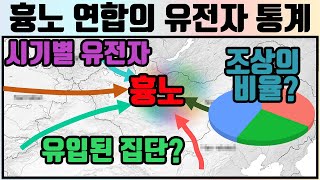
Participants expressed strong interest in the genetic diversity and migration patterns, exemplified by phrases like 'diverse haplogroups' and 'possible migrations,' emphasizing the importance of these findings. The tone ranged from scientific curiosity to speculation about ancient social structures, reflecting both engagement with technical details and the broader historical significance.
AgreementModerate agreement
Most discussions supported the significance of discovering a Western Eurasian male in the ancient Xiongnu context, noting the implications for understanding migration and social complexity.
InterestHigh interest
Participants displayed high curiosity, with many focusing on the connection to Indo-European migrations and ancient Eurasian interactions.
EngagementHigh engagement
Analyses delved into genetic details, such as haplogroups and burial contexts, showing in-depth engagement with the research findings.
ImpactModerate impact
The findings are viewed as potentially transformative for understanding ancient Eurasian history, though some discussions question the broader implications.
Abstract in brief
The genetic analysis of three ancient skeletons from a 2000-year-old Xiongnu cemetery in Mongolia revealed diverse haplogroups, with one male carrying Indo-European R1a1 and maternal U2e1 haplogroups, suggesting possible migrations of Indo-Europeans into Northeast Asia.
The findings included a female with Northeast Asian haplogroups (D4) and a male with C3 and D4 haplogroups, indicating genetic diversity within the Xiongnu population, without close kinship among the individuals.
The presence of a West Eurasian male and the artifact evidence point to complex social structures and potential racial tolerance within the Xiongnu Empire, and the genetic data may shed light on ancient migration and East-West interactions.]
@Adbhpvohvgov Duurlig Nars cemetery, elite square tomb number 2, size ~10x10 meter (as large as TAK 1 and 2) Y-STR result (also SNP confirmed) from 2010:
C2a
(another sample from another grave is R1a)
https://t.co/2pnGnb0ZiR
U.S. DEPARTMENT OF JUSTICE
A Western Eurasian Male Is Found in 2000-Year-Old Elite Xiongnu Cemetery in Northeast Mongolia
NCJ Number 308279
Journal American Journal of Physical Anthropology Volume: 142 Issue: 3 Dated: 2010 Pages: 429-440
Author(s)
https://t.co/H1kJeHQbll https://t.co/VGnVecvCaM
This video explores the dynamic 6,000-year genetic history of Eurasia's Eastern Steppe, based on comprehensive research and recent developments in genetic studies. The findings highlight significant cultural connections…
Genetic analysis of three ancient skeletons from a 2000-year-old Xiongnu cemetery in Mongolia revealed diverse haplogroups, including a West Eurasian male with Indo-European R1a1. The findings suggest complex migration…
@Adbhpvohvgov Duurlig Nars cemetery, elite square tomb number 2, size ~10x10 meter (as large as TAK 1 and 2) Y-STR result (also SNP confirmed) from 2010:
C2a
(another sample from another grave is R1a)
https://t.co/2pnGnb0ZiR
U.S. DEPARTMENT OF JUSTICE
A Western Eurasian Male Is Found in 2000-Year-Old Elite Xiongnu Cemetery in Northeast Mongolia
NCJ Number 308279
Journal American Journal of Physical Anthropology Volume: 142 Issue: 3 Dated: 2010 Pages: 429-440
Author(s)
https://t.co/H1kJeHQbll https://t.co/VGnVecvCaM
Kim K., Brenner C.H., Mair V.H. Et Al. - A Western Eurasian Male Is ...
News
... 10.1002/ajpa.21242 proposed as Yeniseian, Iranian, Turkic, or Mongolic Published online 20 January 2010 in Wiley InterScience (Adas, 2001; Di Cosmo, 2002) ...
The 10000 Year Long Hungarian Continuitas | PDF | Hungarians ...
News
... 10.1002/ajpa.21242. 6) Kyung-Yong Kim of Chung-Ang University in Seoul, South Korea. 7) “Xiongnu tombs of Durlig Nars”, Academy of Sciences of Mongolia. 8 ...
 S
S E
E A
A A
A WD
WD DB
DB