Discussions reflect a balanced curiosity about the scientific hypotheses presented in the publication, with posts mentioning the various mechanisms like shock and trauma-induced coagulopathy, as well as noting the importance of integrating medical hypotheses with historical or religious perspectives. The tone varies from skeptical to inquisitive, with some posts questioning the relevance while others highlight the scientific value of understanding the physiological details.
AgreementNeither agree nor disagree
The discussions show mixed opinions, with some acknowledging the scientific approach, but others questioning the relevance to faith or historical interpretation.
InterestModerate interest
The group shows mild to moderate interest, with some posts referencing the scientific detail and others calling for further research or clarification.
EngagementModerate engagement
Participants reference specific hypotheses and the scientific process, indicating a moderate level of thoughtful engagement rather than dismissiveness.
ImpactNeutral impact
The overall influence appears limited, mostly revolving around academic curiosity and discussion rather than real-world implications or change.
Abstract in brief
The text discusses the controversy and medical theories surrounding the exact cause of Jesus' death during crucifixion, noting that there is no consensus among physicians on the precise mechanism.
Various hypotheses have been proposed, including pulmonary embolism, cardiac rupture, suspension trauma, asphyxiation, fatal stab wound, and shock, each with different implications for understanding the process of death.
The review emphasizes that traumatic shock, potentially complicated by trauma-induced coagulopathy, may be a primary factor in Jesus' death, highlighting the complex physiological effects of crucifixion.
En la literatura médica se han presentado varias hipótesis sobre el mecanismo de la muerte de Jesús. Este artículo describe los eventos de la ejecución.
J Forensic Leg Med. 2012 Apr;19(3):113-6. doi: 10.1016/j.jflm.2011.06.001. Epub 2011 Jul 12. PMID: 22390994.
#SoMe4PedSurg https://t.co/09odOFBATg
This video explores the medical perspective on Jesus' death during crucifixion, analyzing hypotheses such as shock, trauma, and coagulopathy, and how these factors contributed to his demise, based on biblical and…
Examining various hypotheses on the pathophysiology of Jesus' death, including shock and trauma-induced coagulopathy, with a focus on complex physiological effects of crucifixion and potential mechanisms like pulmonary…
The crucifixion of Jesus: Review of hypothesized mechanisms of death and implications of shock and trauma-induced coagulopathy - ScienceDirect https://t.co/vuiEQaAREi
En la literatura médica se han presentado varias hipótesis sobre el mecanismo de la muerte de Jesús. Este artículo describe los eventos de la ejecución.
J Forensic Leg Med. 2012 Apr;19(3):113-6. doi: 10.1016/j.jflm.2011.06.001. Epub 2011 Jul 12. PMID: 22390994.
#SoMe4PedSurg https://t.co/09odOFBATg
Ubmc 34 1951096 | PDF | Crucifixion Of Jesus | Jesus
News
J Forensic Leg Med. 2012;19(3):113–116. doi:10.1016/j.jflm. 2011.06.001. as well as the position of the body when nailed to the cross. 4. Strauss D. A New ...
Asi Sleep | PDF | Child Abuse | Child Sexual Abuse
News
Pediatrics 1990;86(6):896e901. Leg Med 2018;53:17e21. https://doi.org/10.1016/j.jflm.2017.10.012. ... https://doi.org/10.1016/j.smrv.2011.06.001. sectional ...
 AF
AF W
W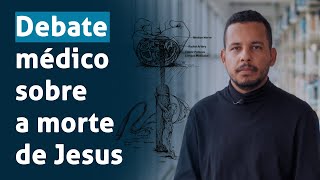

 SG
SG