The group displays a strong interest in the implications of intuitive eating, exemplified by posts referencing specific definitions, related research, and sharing documentation. The tone and context reveal curiosity about the research's broader applications, such as its effect on athletes and mental health, contributing to a sense of meaningful engagement and moderate recognition of its importance.
AgreementModerate agreement
Most posts acknowledge that intuitive eating has certain health benefits, such as weight maintenance and improved psychological health, showing general agreement.
InterestHigh interest
Discussions indicate a high level of curiosity, with posts referencing definitions, related papers, and potential implications for athletes and nutrition.
EngagementHigh engagement
Participants actively share thoughts, cite research, and ask for opinions, suggesting deep engagement with the topic.
ImpactModerate impact
While some recognize the review's significance, the overall impact appears moderate, as the discussion remains somewhat exploratory and academic.
Abstract in brief
The review summarizes studies on intuitive eating, defining it as eating when hungry, stopping when full, and having no food restrictions unless medically necessary, and examines its links to physical and mental health.
The analyzed research, including 26 peer-reviewed articles, shows that intuitive eating is generally associated with a lower BMI and better psychological health, though it doesn't seem to increase physical activity.
Future research is suggested to explore more diverse health outcomes, long-term effects, and the mechanisms behind how intuitive eating influences health indicators.]
@BulldogTCOB You might find this review helpful. Van Dyke, N., & Drinkwater, E. (2014). Review Article Relationships between intuitive eating and health indicators: Literature review. Public Health Nutrition, 17(8), 1757-1766. doi:10.1017/S1368980013002139
@StefanFSchubert The definition of "intuitive eating" includes "stopping when full". It's not a wholly literal phrase.
https://t.co/5EEE4OeC9E https://t.co/jG837m1vbP
@Qban_Linx Had thoughts that couldn't fit into a tweet so I'm just going to screen shot them here. And here's a couple of papers aggregating the studies on this which form much of the basis for my thoughta (I used scihub to access the text). https://t.co/sxGjrR4Zy5
https://t.co/Y6kvlk9fFu https://t.co/7tfwJQBqAL
Sep 15, 2022 · 1 like · 1,606 followersView post →
The implementation of #intuitive eating results in #weight maintenance but perhaps not weight loss, improved #psychological #health, possibly improved physical health indicators other than BMI & dietary intake and/or eating behaviours. #athletes #nutrition
https://t.co/Gr7W83xz7H
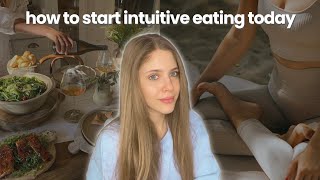
This video provides a practical approach to regaining food intuition, encouraging mindful eating and browsing. It offers tips and resources to help you listen to your body’s needs and improve your relationship with food.
This video explores the principles of intuitive eating and their impact on psychological health. It delves into the science behind intuitive eating, the emergence of its concept, and how adopting its principles can lead…
The implementation of #intuitive eating results in #weight maintenance but perhaps not weight loss, improved #psychological #health, possibly improved physical health indicators other than BMI & dietary intake and/or eating behaviours. #athletes #nutrition
https://t.co/Gr7W83xz7H
@StefanFSchubert The definition of "intuitive eating" includes "stopping when full". It's not a wholly literal phrase.
https://t.co/5EEE4OeC9E https://t.co/jG837m1vbP
@Qban_Linx Had thoughts that couldn't fit into a tweet so I'm just going to screen shot them here. And here's a couple of papers aggregating the studies on this which form much of the basis for my thoughta (I used scihub to access the text). https://t.co/sxGjrR4Zy5
https://t.co/Y6kvlk9fFu https://t.co/7tfwJQBqAL
Sep 15, 2022 · 1 like · 1,606 followersView post →
LD
love dive
@wonyoseolove · X
@sexyman48 @HuffPost Sure go ahead. https://t.co/A0AHlmjcLT
https://t.co/oPmDuw6lky
https://t.co/xq1eH0vrX9
https://t.co/8YZvlgsb3O
@BulldogTCOB You might find this review helpful. Van Dyke, N., & Drinkwater, E. (2014). Review Article Relationships between intuitive eating and health indicators: Literature review. Public Health Nutrition, 17(8), 1757-1766. doi:10.1017/S1368980013002139
 CH
 DP
 S
 T
 RD
 JH


 LD
 N