The collection of discussions shows strong support for the article's emphasis on ethical decision-making, as seen in comments about its influence on clinical teams and debates around risk management rather than connection. The tone is both appreciative and critical, reflecting an engaged audience that values the article's practical and ethical insights, with phrases like 'delighted to learn' and references to real-world use illustrating the article's impact.
AgreementModerate agreement
Posts generally support the ideas about ethical risk management and its importance, seeing the article as aligned with or echoing prior work.
InterestHigh interest
Discussions reflect high engagement and curiosity, especially regarding practical applications and the critique of risk-focused approaches.
EngagementModerate engagement
Comments reference personal experiences, implementations in clinical settings, and theoretical debates, indicating active involvement.
ImpactModerate impact
The discussion highlights ongoing influence in clinical practice and research, with mentions of real-world applications and recognitions.
Abstract in brief
The article discusses the challenges faced by healthcare providers in managing patients with borderline personality disorder, particularly around using crisis intervention to prevent suicide, which raises ethical questions about balancing benefits and harms.
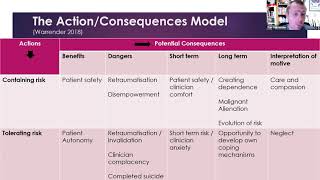
It introduces an action-consequence model that evaluates clinical decisions based on moral principles like beneficence (doing good) and nonmaleficence (avoiding harm), helping staff navigate complex situations.
The model aims to improve clinical decision-making by assessing potential outcomes of interventions, ensuring ethical principles are upheld while managing the risks associated with borderline personality disorder.]
@RTimoclea I wrote this around inpatient admission a couple of years ago. I think it's often not useful due to a focus on risk management rather than connection and therapeutic engagement. So it can be harmful, and that's because services have the wrong focus. https://t.co/RTYN6V1Dkn
Jun 24, 2020 · 11 likes · 3,717 followersView post →
DW
Dr Dan Warrender
@dan_warrender · X
A related paper of mine argues about ethics of risk management in hospital, and echoes some of Paris's ideas. I argue that 'safety' (which may not even feel safe) doesn't mean well, and containment does not mean treatment (on researchgate if you need).
https://t.co/RqbuGFikcP
@robmarki @brodiecalm1 I wote this a couple of years ago, and was recently delighted to learn that teams in Glasgow are using it to frame complex case discussions. Going to speak to them next month. Really interested to hear how it has worked in practice. https://t.co/CgHsNnYlPq
Feb 28, 2020 · 2 likes · 3,717 followersView post →
T
TheWrongKindOfMad
@WrongKindOfMad · X
RT @dan_warrender: A related paper of mine argues about ethics of risk management in hospital, and echoes some of Paris's ideas. I argue t…
This is a very brief introduction to an incredibly complex topic and only scratches the surface of many important concepts. The study highlights diverse crisis experiences of individuals with BPD and emphasizes the need…
This presentation introduces an action-consequences model for risk management in people diagnosed with BPD. It emphasizes balanced, effective interventions that avoid extremes, based on recent research and…
This presentation explores the experiences of individuals diagnosed with borderline personality disorder, emphasizing diverse crisis encounters and the need for tailored intervention strategies to improve care quality…
A related paper of mine argues about ethics of risk management in hospital, and echoes some of Paris's ideas. I argue that 'safety' (which may not even feel safe) doesn't mean well, and containment does not mean treatment (on researchgate if you need).
https://t.co/RqbuGFikcP
@RTimoclea I wrote this around inpatient admission a couple of years ago. I think it's often not useful due to a focus on risk management rather than connection and therapeutic engagement. So it can be harmful, and that's because services have the wrong focus. https://t.co/RTYN6V1Dkn
Jun 24, 2020 · 11 likes · 3,717 followersView post →
DW
Dr Dan Warrender
@dan_warrender · X
@robmarki @brodiecalm1 I wote this a couple of years ago, and was recently delighted to learn that teams in Glasgow are using it to frame complex case discussions. Going to speak to them next month. Really interested to hear how it has worked in practice. https://t.co/CgHsNnYlPq
Feb 28, 2020 · 2 likes · 3,717 followersView post →
 DW
DW T
T