The discussion mainly revolves around related research and sharing interest in the publication, exemplified by mentions of similar work and offers to continue the conversation. The tone reflects academic curiosity rather than strong opinions, with phrases like 'also similar work from...' and 'I'd be happy to talk more' demonstrating tentative engagement and moderate interest.
AgreementNeither agree nor disagree
The discussion shows neutral sentiment, with some acknowledging the work but no strong consensus.
InterestModerate interest
The posts indicate a modest level of curiosity, noting similar work and offering to discuss further.
EngagementModerate engagement
Participants reference related researchers and express willingness to engage, but the depth remains limited.
ImpactNeutral impact
The conversation hints at recognition within a specialized community but does not suggest widespread influence.
Abstract in brief
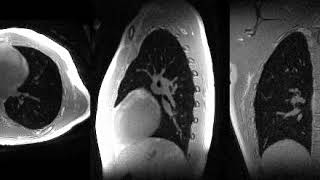
The study developed a specialized 3D MRI technique that captures high-resolution images of the lungs during free breathing, using a dynamic self-navigator reconstructed from the imaging data itself to track respiratory motion.
They used two methods—softgating and motion-resolved techniques—to correct for breathing motion, resulting in clearer images even when scanning during irregular or shallow breathing.
This approach proved effective in both volunteers and patients, enabling detailed visualization of lung structures and pathologies, with improvements over traditional motion tracking methods.]
High-resolution lung images acquired with MRI during free breathing in 5 minutes. The method employs dynamic self-navigators to correct respiratory motion, enabling detailed visualization of lung structures without…
Sample image navigators from patients with various patterns of regular and irregular breathing, demonstrating the effectiveness of dynamic self-navigation in high-resolution lung imaging during free breathing, improving…
 PL
PL