The overall discussions reveal enthusiasm about the flashlight fish's bioluminescent abilities, with posts describing how these fish use their built-in 'flashlights' for navigation and communication. Words like 'amazing,' 'nature is really cool,' and references to scientific videos and studies demonstrate both interest and recognition of scientific importance, reflecting a positive and engaged perception of the research.
AgreementModerate agreement
Most discussions express fascination and approval of the study, highlighting the biological marvel of flashlight fish and their unique adaptations.
InterestHigh interest
Participants show high curiosity, sharing resources, praising nature's innovations, and referencing related scientific content, reflecting widespread engagement.
EngagementModerate engagement
Several posts actively discuss the mechanisms of bioluminescence and its evolutionary significance, indicating meaningful participation.
ImpactModerate impact
The discussions suggest an appreciation of the significance of such research in understanding marine biology and evolution, though primarily on an educational level.
Abstract in brief
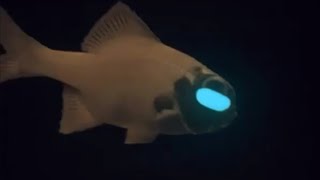
The study examined how the flashlight fish Anomalops katoptron detects blue bioluminescent light, focusing on its visual system which includes rods and cones, with special pigments (rhodopsins) sensitive to around 490 nm wavelength, matching the fish's bioluminescence.
Researchers used phylogenetic, electrophysiological, and behavioral methods, finding that A. katoptron is attracted to low-intensity blue light but not red light, indicating an adaptation to detect its bioluminescent environment.
The findings suggest that the fish's visual system is specifically tuned to perceive blue light within the same spectrum as its own bioluminescence and starlight, likely aiding in communication and environmental navigation.]
Some additional resources & studies on this unusual species and their flashlight eyes.
https://t.co/nT41yPttTn
https://t.co/Ip88H99Ega
https://t.co/nKwJt2CYI5
Mar 18, 2023 · 92 likes · 4 shares · 9,802 followersView post →
AR
Arctostaphylos Regismontana
@arctostaphylos-r.bsky.social · Bluesky
The Flashlight Fish, of course!
youtu.be/lURhJrFkJ_M?...
No one likes to eat dinner in the dark, which is why these deep sea dwellers come with their own flashlights!
https://t.co/EUXYmH6w0H https://t.co/UUXyeQEJDx
Nov 9, 2020 · 25 likes · 4 shares · 112,387 followersView post →
JD
John P. Friel, Ph.D.
@friel · X
Active photolocation in fishes via occular sparks and photophores. In the words of @Sternarchella, "Call me when a bird does this... I'll wait".
https://t.co/KShCp3t0fn
Nov 9, 2020 · 6 likes · 5 shares · 7,647 followersView post →
KP
Kory Yanfei (Evans PhD)
@KoryYanfei · X
RT @friel: Active photolocation in fishes via occular sparks and photophores. In the words of @Sternarchella, "Call me when a bird does thi…
Nov 9, 2020 · 5 shares · 12,617 followersView post →
KD
Kim Landsbergen Ph.D.
@treebiology · X
RT @friel: Active photolocation in fishes via occular sparks and photophores. In the words of @Sternarchella, "Call me when a bird does thi…
Nov 9, 2020 · 5 shares · 2,647 followersView post →
This video explores how the flashlight fish Anomalops katoptron detects blue bioluminescent light. Its visual system is specially adapted with rhodopsins sensitive to 490 nm wavelength, aiding in communication and…
The study explores how the flashlight fish Anomalops katoptron detects blue bioluminescent light, focusing on its visual system which includes rods and cones with specialized pigments sensitive to around 490 nm, aiding…
Some additional resources & studies on this unusual species and their flashlight eyes.
https://t.co/nT41yPttTn
https://t.co/Ip88H99Ega
https://t.co/nKwJt2CYI5
Mar 18, 2023 · 92 likes · 4 shares · 9,802 followersView post →
.@SciShow published daily videos about current questions from the world of science.
https://t.co/Eb8JSny8o2
Newsletter:
https://t.co/jsq9u5dDiI
#biology #science #scishow #trivia #fish #flashlights https://t.co/nNzTiOLF6y
No one likes to eat dinner in the dark, which is why these deep sea dwellers come with their own flashlights!
https://t.co/EUXYmH6w0H https://t.co/UUXyeQEJDx
Nov 9, 2020 · 25 likes · 4 shares · 112,387 followersView post →
JD
John P. Friel, Ph.D.
@friel · X
Active photolocation in fishes via occular sparks and photophores. In the words of @Sternarchella, "Call me when a bird does this... I'll wait".
https://t.co/KShCp3t0fn
Nov 9, 2020 · 6 likes · 5 shares · 7,647 followersView post →
EC
e-csce
@e_csce · X
3 Fish With Built-In Flashlights @ https://t.co/d3AfgJE0gv https://t.co/6UeKKVTu7V
Bacterial Origin of Luminescence in Marine Animals | Science
News
... (e0198765), (2018).https://doi.org/10.1371/journal.pone.0198765 · Crossref. Ilan Karplus,. The Associations between Fishes and Luminescent Bacteria, Symbiosis in ...
 CR

 DR
 CS
 KC
 EG