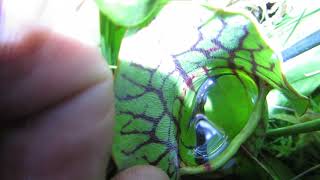
Many discussions revolve around the surprising role of pitcher plants in consuming salamanders, with users expressing fascination with phrases like 'Plants EATING salamanders, anyone?' and referencing the importance of this finding in terms of nutrient cycling. The tone is predominantly enthusiastic, evident in comments about the uncovering of unexpected ecological relationships, suggesting that users feel both intrigued and informed by the research.
AgreementModerate agreement
Most discussions express a positive view towards the findings, highlighting the role of salamanders in these ecosystems.
InterestHigh interest
Participants show a high level of curiosity, as many posts ask questions and seek further information about the topic.
EngagementModerate engagement
Several posts reference further research and engage with specific examples, but most interactions remain surface-level.
ImpactHigh impact
The discussions indicate a belief that the publication significantly enhances understanding of ecological interactions and dynamics.
Abstract in brief
Salamanders are caught in pitfall traps, which are natural traps that help demonstrate their role in the ecosystem.
These salamanders serve as a nutrient-rich food source for carnivorous plants, particularly in nutrient-poor environments like northern bogs.
The study emphasizes the importance of salamanders in nutrient cycling within these unique ecosystems, highlighting their ecological interactions.
La plante Sarracénie pourpre, appelée "chaussette de tortue", est une plante carnivore qui capture ses proies...en les noyant !
Une fois tombées dans ses feuilles en forme de gobelet, même de petites salamandres sont dissoutes et digérées !
https://t.co/TXlJhsyjdB https://t.co/s77oBj0Ef2
Feb 10, 2021 · 503 likes · 81 shares · 332,511 followersView post →
YS
Y a r a • يارا • Hectic Skeleton
@Yara_Haridy · X
Plants preying on Vertebrates!
An amazing new paper from Patrick Moldowan and team showing instances of salamanders caught in pitcher plants!
https://t.co/M1AhHPM2Ib https://t.co/KjM0Id08gC
Jun 8, 2019 · 80 likes · 20 shares · 20,127 followersView post →
WH
World Congress of Herpetology
@WCHerp · X
Salamander-eating plants?! #WCH9 scholarship recipient Patrick Moldowan, will be presenting on 07 Jan at 10:00, Ecological Interactions I session, St David F: ''Nature's pitfall trap: salamanders as rich prey for carnivorous plants in a nutrient-poor bog ecosystem" @AlgonquinWRS https://t.co/CmjtxWKNs9
Jan 5, 2020 · 53 likes · 15 shares · 2,258 followersView post →
AS
Algonquin Wildlife Research Station
@AlgonquinWRS · X
Plants EATING salamanders, anyone? "Nature's pitfall trap: Salamanders as rich prey for carnivorous plants in a nutrient‐poor northern bog ecosystem" from @AlgonquinWRS
Now out @ESA_org
https://t.co/TQiq25AUbA
https://t.co/Af1FFIWXX4
Roll w/ press releases...
#AmphibiousAF https://t.co/eQnS0ZSQlp
Jun 6, 2019 · 30 likes · 14 shares · 2,696 followersView post →
SP
Sarah McGrath-Blaser, PhD
@BlasinAmphibs · X
Glamour shots of some northern pitcher plants -Sarracenia purpurea purpurea- from #AlgonquinProvinvalPark in Ontario, Canada. While we only found them eating inverts, plants in this range have been known to consume salamanders
Salamanders are on the move! Continuing research with @Alex_Smith_Ants and @AlgonquinWRS to uncover the mysteries behind the success of pitcher plants in capturing amphibian prey
https://t.co/aPckFM46xK https://t.co/lDGc9zmhO5
Aug 11, 2019 · 26 likes · 9 shares · 221 followersView post →
New research demonstrates how salamanders serve as a nutrient-rich food source for carnivorous plants in nutrient-poor northern bogs. This video showcases the role of Spotted Salamanders trapped by the Northern Pitcher…
New research reveals how salamanders serve as rich prey for carnivorous plants in nutrient-poor northern bogs. This video showcases young Spotted Salamanders caught in a Northern Pitcher Plant, illustrating their…
Harriet Carroll: Long Covid Scientific Consultancy
@angryhacademic · X
RT @angryhacademic: Fun fact: we've all probably heard of bug eating carnivorous plants like the venus fly trap, but pitcher plants go one…
Oct 11, 2025 · 1 share · 8,764 followersView post →
HC
Harriet Carroll: Long Covid Scientific Consultancy
@angryhacademic · X
Fun fact: we've all probably heard of bug eating carnivorous plants like the venus fly trap, but pitcher plants go one step further and "eat" young salamanders
https://t.co/17TawvV2L5
Easy read: https://t.co/dagkvEHWyt
Oct 11, 2024 · 3 likes · 1 share · 8,764 followersView post →
TS
Thorsten Schwerte
@tschwerte · X
Fressen fleischfressende Pflanzen auch Wirbeltiere? https://t.co/TPxSo6miz5 via @YouTube
Glamour shots of some northern pitcher plants -Sarracenia purpurea purpurea- from #AlgonquinProvinvalPark in Ontario, Canada. While we only found them eating inverts, plants in this range have been known to consume salamanders
RT @tuCpakoa: La plante Sarracénie pourpre, appelée "chaussette de tortue", est une plante carnivore qui capture ses proies...en les noyant…
Feb 11, 2021 · 81 shares · 39 followersView post →
DV
don diego de la vega
@DonDiegoDeLaV8 · X
RT @tuCpakoa: La plante Sarracénie pourpre, appelée "chaussette de tortue", est une plante carnivore qui capture ses proies...en les noyant…
Feb 11, 2021 · 81 shares · 2,003 followersView post →
N
Nico
@MrProwerYTB · X
RT @tuCpakoa: La plante Sarracénie pourpre, appelée "chaussette de tortue", est une plante carnivore qui capture ses proies...en les noyant…
Feb 10, 2021 · 81 shares · 320 followersView post →
TO
The Chosen One
@Moustoifa · X
RT @tuCpakoa: La plante Sarracénie pourpre, appelée "chaussette de tortue", est une plante carnivore qui capture ses proies...en les noyant…
Feb 10, 2021 · 81 shares · 321 followersView post →
CE
Crispin Enyanga
@EnyangaCrispin · X
RT @tuCpakoa: La plante Sarracénie pourpre, appelée "chaussette de tortue", est une plante carnivore qui capture ses proies...en les noyant…
Feb 10, 2021 · 81 shares · 43 followersView post →
MF
Made In France
@GMahidine · X
RT @tuCpakoa: La plante Sarracénie pourpre, appelée "chaussette de tortue", est une plante carnivore qui capture ses proies...en les noyant…
Feb 10, 2021 · 81 shares · 29 followersView post →
SR
Slim Reaper
@Will_I_AmScorpo · X
RT @tuCpakoa: La plante Sarracénie pourpre, appelée "chaussette de tortue", est une plante carnivore qui capture ses proies...en les noyant…
Feb 10, 2021 · 81 shares · 846 followersView post →
B
Bandicapé
@FergalDum · X
RT @tuCpakoa: La plante Sarracénie pourpre, appelée "chaussette de tortue", est une plante carnivore qui capture ses proies...en les noyant…
Feb 10, 2021 · 81 shares · 54 followersView post →
M
Mastho__
@Mastho__ · X
RT @tuCpakoa: La plante Sarracénie pourpre, appelée "chaussette de tortue", est une plante carnivore qui capture ses proies...en les noyant…
Feb 10, 2021 · 81 shares · 98 followersView post →
A
Anissa34
@anissa202 · X
RT @tuCpakoa: La plante Sarracénie pourpre, appelée "chaussette de tortue", est une plante carnivore qui capture ses proies...en les noyant…
Feb 10, 2021 · 81 shares · 302 followersView post →
ك
كو
@s_kaou · X
RT @tuCpakoa: La plante Sarracénie pourpre, appelée "chaussette de tortue", est une plante carnivore qui capture ses proies...en les noyant…
Feb 10, 2021 · 81 shares · 11 followersView post →
D
DreamHope
@DreamHope59 · X
RT @tuCpakoa: La plante Sarracénie pourpre, appelée "chaussette de tortue", est une plante carnivore qui capture ses proies...en les noyant…
Feb 10, 2021 · 81 shares · 577 followersView post →
F
Fg
@azekf · X
RT @tuCpakoa: La plante Sarracénie pourpre, appelée "chaussette de tortue", est une plante carnivore qui capture ses proies...en les noyant…
Feb 10, 2021 · 81 shares · 97 followersView post →
S
Sofiane
@SofianeKbaily · X
RT @tuCpakoa: La plante Sarracénie pourpre, appelée "chaussette de tortue", est une plante carnivore qui capture ses proies...en les noyant…
Feb 10, 2021 · 81 shares · 173 followersView post →
DN
Don Nahasapeemapetilon
@Agbo__Yannick · X
RT @tuCpakoa: La plante Sarracénie pourpre, appelée "chaussette de tortue", est une plante carnivore qui capture ses proies...en les noyant…
Feb 10, 2021 · 81 shares · 2,180 followersView post →
H
Hurluberlu ☮️
@saracrocher · X
RT @tuCpakoa: La plante Sarracénie pourpre, appelée "chaussette de tortue", est une plante carnivore qui capture ses proies...en les noyant…
Feb 10, 2021 · 81 shares · 170 followersView post →
L
Lilie
@liliebb78 · X
RT @tuCpakoa: La plante Sarracénie pourpre, appelée "chaussette de tortue", est une plante carnivore qui capture ses proies...en les noyant…
Feb 10, 2021 · 81 shares · 149 followersView post →
P
Praxis
@PraxiisL · X
RT @tuCpakoa: La plante Sarracénie pourpre, appelée "chaussette de tortue", est une plante carnivore qui capture ses proies...en les noyant…
Feb 10, 2021 · 81 shares · 240 followersView post →
B
B
@benjiblen · X
RT @tuCpakoa: La plante Sarracénie pourpre, appelée "chaussette de tortue", est une plante carnivore qui capture ses proies...en les noyant…
Feb 10, 2021 · 81 shares · 43 followersView post →
R
Romajiiiiiii
@Romajiiiiiii · X
RT @tuCpakoa: La plante Sarracénie pourpre, appelée "chaussette de tortue", est une plante carnivore qui capture ses proies...en les noyant…
Feb 10, 2021 · 81 shares · 97 followersView post →
S
75Sebthom
@75Sebthom · X
RT @tuCpakoa: La plante Sarracénie pourpre, appelée "chaussette de tortue", est une plante carnivore qui capture ses proies...en les noyant…
Feb 10, 2021 · 81 shares · 201 followersView post →
G
Gardy
@PieG27 · X
RT @tuCpakoa: La plante Sarracénie pourpre, appelée "chaussette de tortue", est une plante carnivore qui capture ses proies...en les noyant…
Feb 10, 2021 · 81 shares · 7,453 followersView post →
MN
mathis neau
@Lolamathis17 · X
RT @tuCpakoa: La plante Sarracénie pourpre, appelée "chaussette de tortue", est une plante carnivore qui capture ses proies...en les noyant…
Feb 10, 2021 · 81 shares · 42 followersView post →
OA
Ouattara Abdoul Aziz
@Ouattar48360918 · X
RT @tuCpakoa: La plante Sarracénie pourpre, appelée "chaussette de tortue", est une plante carnivore qui capture ses proies...en les noyant…
Feb 10, 2021 · 81 shares · 1,152 followersView post →
K
KKAR
@ArmandKoumda · X
RT @tuCpakoa: La plante Sarracénie pourpre, appelée "chaussette de tortue", est une plante carnivore qui capture ses proies...en les noyant…
Feb 10, 2021 · 81 shares · 12,720 followersView post →
M
MayeewS
@MayeewS · X
RT @tuCpakoa: La plante Sarracénie pourpre, appelée "chaussette de tortue", est une plante carnivore qui capture ses proies...en les noyant…
Feb 10, 2021 · 81 shares · 1,434 followersView post →
M
Malou
@MrtnMalou · X
RT @tuCpakoa: La plante Sarracénie pourpre, appelée "chaussette de tortue", est une plante carnivore qui capture ses proies...en les noyant…
Feb 10, 2021 · 81 shares · 169 followersView post →
T
Tottanan
@tottanan · X
RT @tuCpakoa: La plante Sarracénie pourpre, appelée "chaussette de tortue", est une plante carnivore qui capture ses proies...en les noyant…
Feb 10, 2021 · 81 shares · 632 followersView post →
E
91ers
@iAmKHenriCk91 · X
RT @tuCpakoa: La plante Sarracénie pourpre, appelée "chaussette de tortue", est une plante carnivore qui capture ses proies...en les noyant…
Feb 10, 2021 · 81 shares · 2,552 followersView post →
M
mi
@PTAMF_ · X
RT @tuCpakoa: La plante Sarracénie pourpre, appelée "chaussette de tortue", est une plante carnivore qui capture ses proies...en les noyant…
Feb 10, 2021 · 81 shares · 2,026 followersView post →
N
Nocturmaths
@Piemontaise35 · X
RT @tuCpakoa: La plante Sarracénie pourpre, appelée "chaussette de tortue", est une plante carnivore qui capture ses proies...en les noyant…
Feb 10, 2021 · 81 shares · 296 followersView post →
C
csa2016
@nathalie197125 · X
RT @tuCpakoa: La plante Sarracénie pourpre, appelée "chaussette de tortue", est une plante carnivore qui capture ses proies...en les noyant…
Feb 10, 2021 · 81 shares · 620 followersView post →
S
So
@OkiPik · X
RT @tuCpakoa: La plante Sarracénie pourpre, appelée "chaussette de tortue", est une plante carnivore qui capture ses proies...en les noyant…
Feb 10, 2021 · 81 shares · 111 followersView post →
JB
Jérôme Boyé
@cameleon3324 · X
RT @tuCpakoa: La plante Sarracénie pourpre, appelée "chaussette de tortue", est une plante carnivore qui capture ses proies...en les noyant…
Feb 10, 2021 · 81 shares · 404 followersView post →
H
hugo
@Hu_gosport · X
RT @tuCpakoa: La plante Sarracénie pourpre, appelée "chaussette de tortue", est une plante carnivore qui capture ses proies...en les noyant…
Feb 10, 2021 · 81 shares · 188 followersView post →
ཧ
ཧᜰ꙰ꦿ➢
@kutmine · X
RT @tuCpakoa: La plante Sarracénie pourpre, appelée "chaussette de tortue", est une plante carnivore qui capture ses proies...en les noyant…
Feb 10, 2021 · 81 shares · 504 followersView post →
FS
fosse sCeptique
@FSeptique · X
RT @tuCpakoa: La plante Sarracénie pourpre, appelée "chaussette de tortue", est une plante carnivore qui capture ses proies...en les noyant…
Feb 10, 2021 · 81 shares · 640 followersView post →
LO
LuxNeko Online
@LucasGenart · X
RT @tuCpakoa: La plante Sarracénie pourpre, appelée "chaussette de tortue", est une plante carnivore qui capture ses proies...en les noyant…
Feb 10, 2021 · 81 shares · 916 followersView post →
FU
Freefan2U
@Freefan2U · X
RT @tuCpakoa: La plante Sarracénie pourpre, appelée "chaussette de tortue", est une plante carnivore qui capture ses proies...en les noyant…
Feb 10, 2021 · 81 shares · 849 followersView post →
F
❣ForEverAnimaux❣
@FKbriochine · X
RT @tuCpakoa: La plante Sarracénie pourpre, appelée "chaussette de tortue", est une plante carnivore qui capture ses proies...en les noyant…
Feb 10, 2021 · 81 shares · 1,095 followersView post →
S
stolon
@stolonPharma · X
RT @tuCpakoa: La plante Sarracénie pourpre, appelée "chaussette de tortue", est une plante carnivore qui capture ses proies...en les noyant…
Feb 10, 2021 · 81 shares · 236 followersView post →
PZ
Pr Dr ZOUAGHI-
@DrZouaghi · X
RT @tuCpakoa: La plante Sarracénie pourpre, appelée "chaussette de tortue", est une plante carnivore qui capture ses proies...en les noyant…
Feb 10, 2021 · 81 shares · 3,574 followersView post →
TQ
TU SAIS PAS QUOI ?!
@tuCpakoa · X
La plante Sarracénie pourpre, appelée "chaussette de tortue", est une plante carnivore qui capture ses proies...en les noyant !
Une fois tombées dans ses feuilles en forme de gobelet, même de petites salamandres sont dissoutes et digérées !
https://t.co/TXlJhsyjdB https://t.co/s77oBj0Ef2
Feb 10, 2021 · 503 likes · 81 shares · 332,511 followersView post →
CD
Christina Davy
@Christina_Davy · X
@boyleslab This is a good one from @AlgonquinWRS, @Alex_Smith_Ants, @NjalRollinson and others, on pitcher plants pitfall-trapping salamanders: https://t.co/mjrdC57F1z
Dec 29, 2020 · 2 likes · 1,893 followersView post →
LC
Lotte C.
@Oeufquidanse · X
RT @tuCpakoa: La plante Sarracénie pourpre, appelée "chaussette de tortue", est une plante carnivore qui capture ses proies en les noyant !…
RT @WCHerp: Salamander-eating plants?! #WCH9 scholarship recipient Patrick Moldowan, will be presenting on 07 Jan at 10:00, Ecological Inte…
Jan 5, 2020 · 15 shares · 1,322 followersView post →
DK
Dr. Jonathan Kolby
@MyFrogCroaked · X
RT @WCHerp: Salamander-eating plants?! #WCH9 scholarship recipient Patrick Moldowan, will be presenting on 07 Jan at 10:00, Ecological Inte…
Jan 5, 2020 · 15 shares · 16,750 followersView post →
SS
Samantha Stephens
@samsteph_ · X
RT @WCHerp: Salamander-eating plants?! #WCH9 scholarship recipient Patrick Moldowan, will be presenting on 07 Jan at 10:00, Ecological Inte…
Jan 5, 2020 · 15 shares · 634 followersView post →
DF
David Galbraith, PhD, FRCGS
@Sasajewun · X
RT @WCHerp: Salamander-eating plants?! #WCH9 scholarship recipient Patrick Moldowan, will be presenting on 07 Jan at 10:00, Ecological Inte…
Jan 5, 2020 · 15 shares · 1,434 followersView post →
AS
Algonquin Wildlife Research Station
@AlgonquinWRS · X
RT @WCHerp: Salamander-eating plants?! #WCH9 scholarship recipient Patrick Moldowan, will be presenting on 07 Jan at 10:00, Ecological Inte…
Jan 5, 2020 · 15 shares · 2,696 followersView post →
TM
Thomas Merritt
@tjsmerritt · X
RT @WCHerp: Salamander-eating plants?! #WCH9 scholarship recipient Patrick Moldowan, will be presenting on 07 Jan at 10:00, Ecological Inte…
Jan 5, 2020 · 15 shares · 3,209 followersView post →
IM
Ingrid Márquez
@ingrid_marquez7 · X
RT @WCHerp: Salamander-eating plants?! #WCH9 scholarship recipient Patrick Moldowan, will be presenting on 07 Jan at 10:00, Ecological Inte…
Jan 5, 2020 · 15 shares · 515 followersView post →
DR
Dr. Julia Riley
@jr4science · X
RT @WCHerp: Salamander-eating plants?! #WCH9 scholarship recipient Patrick Moldowan, will be presenting on 07 Jan at 10:00, Ecological Inte…
Jan 5, 2020 · 15 shares · 3,142 followersView post →
ĐM
Đamien Mullin
@Damien_Mullin_ · X
RT @WCHerp: Salamander-eating plants?! #WCH9 scholarship recipient Patrick Moldowan, will be presenting on 07 Jan at 10:00, Ecological Inte…
Jan 5, 2020 · 15 shares · 710 followersView post →
WH
World Congress of Herpetology
@WCHerp · X
Salamander-eating plants?! #WCH9 scholarship recipient Patrick Moldowan, will be presenting on 07 Jan at 10:00, Ecological Interactions I session, St David F: ''Nature's pitfall trap: salamanders as rich prey for carnivorous plants in a nutrient-poor bog ecosystem" @AlgonquinWRS https://t.co/CmjtxWKNs9
Jan 5, 2020 · 53 likes · 15 shares · 2,258 followersView post →
SG
Susan Grimbly
@sgrimbly · X
Botanical carnivory: Hungry plants and their #salamander prey https://t.co/ec95M5Z18N via @YouTube "Alex Smith may be bald, but he says his hair stands on end when he thinks about the moment he first spotted a pitcher plant that had devoured a juvenile salamander in a. Park."
If you look, you will find ... !
Researchers in MA, USA, have found a salamander in a pitcher plant. Sound familiar? (here @AlgonquinWRS: https://t.co/tTMoCcL66m)
The list of locations of salamander-pitcher plant interactions is on the rise. Keep looking, folks! https://t.co/p6NVISQTao
Nov 1, 2019 · 7 likes · 2,696 followersView post →
AS
Algonquin Wildlife Research Station
@AlgonquinWRS · X
@hossiet @bellemare_jesse @FishNeedLove2 YES! If you look, you will find!
(https://t.co/tTMoCcL66m)
@bellemare_jesse, is this record from MA, USA?
Also see: Hughes et al. 1999. Herp Review @ssarherps 30(3), p. 160, for Plethodon-pitcher plant obsrvtns
https://t.co/t9MJU1PlrQ
Thanks, @hossiet!
Of interest @amphibs!
Nov 1, 2019 · 2 likes · 2,696 followersView post →
AS
Algonquin Wildlife Research Station
@AlgonquinWRS · X
@ForTheSpiders @ForTheSpider, we recommend publishing these observations. When researching for our paper it was challenging to find records of vert prey in pitcher plants (https://t.co/tTMoCcL66m).
Interesting that you've found dead treefrogs. All our field obs suggest they can escape w/ ease
Nov 1, 2019 · 3 likes · 2,696 followersView post →
IS
I Run with Scissors
@HeRunsWScissors · X
RT @AlgonquinWRS: One is lonely, two is company, and three is downright crowded.
Recently wrapped-up #FieldSeason2019 and continuation of…
Oct 17, 2019 · 6 shares · 459 followersView post →
KM
Kelsey Mitchell
@BogWitch8327 · X
RT @AlgonquinWRS: One is lonely, two is company, and three is downright crowded.
Recently wrapped-up #FieldSeason2019 and continuation of…
Oct 17, 2019 · 6 shares · 338 followersView post →
AS
Amanda Semenuk
@Amanda_RaeS · X
RT @AlgonquinWRS: One is lonely, two is company, and three is downright crowded.
Recently wrapped-up #FieldSeason2019 and continuation of…
Oct 17, 2019 · 6 shares · 221 followersView post →
UE
U of T Environment
@UofTenvironment · X
RT @AlgonquinWRS: One is lonely, two is company, and three is downright crowded.
Recently wrapped-up #FieldSeason2019 and continuation of…
Oct 17, 2019 · 6 shares · 2,785 followersView post →
UE
University of Toronto EEB
@eebtoronto · X
RT @AlgonquinWRS: One is lonely, two is company, and three is downright crowded.
Recently wrapped-up #FieldSeason2019 and continuation of…
Oct 17, 2019 · 6 shares · 2,420 followersView post →
HH
Herpetological Highlights
@herphighlights · X
RT @AlgonquinWRS: One is lonely, two is company, and three is downright crowded.
Recently wrapped-up #FieldSeason2019 and continuation of…
Oct 17, 2019 · 6 shares · 2,804 followersView post →
AS
Algonquin Wildlife Research Station
@AlgonquinWRS · X
One is lonely, two is company, and three is downright crowded.
Recently wrapped-up #FieldSeason2019 and continuation of the #salamander and #carnivorousplant project.
There is already A LOT to add to the findings reported
@ESA_org:
https://t.co/tTMoCcL66m
Stay tuned! https://t.co/ZefKBxwjw3
Oct 17, 2019 · 17 likes · 6 shares · 2,696 followersView post →
IO
Ida Ostovar
@IOstovar · X
RT @Amanda_RaeS: Salamanders are on the move! Continuing research with @Alex_Smith_Ants and @AlgonquinWRS to uncover the mysteries behind…
RT @Amanda_RaeS: Salamanders are on the move! Continuing research with @Alex_Smith_Ants and @AlgonquinWRS to uncover the mysteries behind…
Aug 24, 2019 · 9 shares · 799 followersView post →
DM
Danny McIsaac
@DMcIsaac_ · X
RT @Amanda_RaeS: Salamanders are on the move! Continuing research with @Alex_Smith_Ants and @AlgonquinWRS to uncover the mysteries behind…
Aug 13, 2019 · 9 shares · 219 followersView post →
DJ
Dr Sho Jacobs
@shoshanahjacobs · X
RT @Amanda_RaeS: Salamanders are on the move! Continuing research with @Alex_Smith_Ants and @AlgonquinWRS to uncover the mysteries behind…
Aug 12, 2019 · 9 shares · 12,205 followersView post →
AL
Alannah (Lynn)
@alannahg13 · X
RT @Amanda_RaeS: Salamanders are on the move! Continuing research with @Alex_Smith_Ants and @AlgonquinWRS to uncover the mysteries behind…
Aug 12, 2019 · 9 shares · 248 followersView post →
DF
David Galbraith, PhD, FRCGS
@Sasajewun · X
RT @Amanda_RaeS: Salamanders are on the move! Continuing research with @Alex_Smith_Ants and @AlgonquinWRS to uncover the mysteries behind…
Aug 11, 2019 · 9 shares · 1,434 followersView post →
AS
Algonquin Wildlife Research Station
@AlgonquinWRS · X
RT @Amanda_RaeS: Salamanders are on the move! Continuing research with @Alex_Smith_Ants and @AlgonquinWRS to uncover the mysteries behind…
Aug 11, 2019 · 9 shares · 2,696 followersView post →
AS
Amanda Semenuk
@Amanda_RaeS · X
Salamanders are on the move! Continuing research with @Alex_Smith_Ants and @AlgonquinWRS to uncover the mysteries behind the success of pitcher plants in capturing amphibian prey
https://t.co/aPckFM46xK https://t.co/lDGc9zmhO5
Aug 11, 2019 · 26 likes · 9 shares · 221 followersView post →
HH
Herpetological Highlights
@herphighlights · X
RT @AlgonquinWRS: @SquaMatesPod, @herphighlights, @FieldGuidesPod, @Ologies - are you looking for fodder for future podcasts?
Maybe salama…
Jun 25, 2019 · 2 shares · 2,804 followersView post →
TM
Thomas Merritt
@tjsmerritt · X
RT @AlgonquinWRS: @SquaMatesPod, @herphighlights, @FieldGuidesPod, @Ologies - are you looking for fodder for future podcasts?
Maybe salama…
Jun 24, 2019 · 2 shares · 3,209 followersView post →
AS
Algonquin Wildlife Research Station
@AlgonquinWRS · X
@SquaMatesPod, @herphighlights, @FieldGuidesPod, @Ologies - are you looking for fodder for future podcasts?
Maybe salamanders-eaten-by-carnivorous-plants, type of fodder?
https://t.co/tTMoCcL66m
https://t.co/AXO44NTpR1
https://t.co/g9pLnzq1n6
https://t.co/i57P7JLGid https://t.co/lXsQq4hG6X
Jun 24, 2019 · 3 likes · 2 shares · 2,696 followersView post →
AH
Angela M Mendoza-Henao
@AngyMendozaH · X
The role of amphibians in nutrient cycling on ecosystems is now more complex.
Carnivorous plants eat far more salamanders than scientists thought https://t.co/E2c36gwiQN https://t.co/x6C3kPFuYu #herpetology https://t.co/k3lhOcUfVw
Jun 21, 2019 · 3 likes · 1,214 followersView post →
BH
Brian Hayes
@NBC_HayesAg · X
Botanical carnivory: Hungry plants and their salamander prey https://t.co/ILUH51q2Li via @YouTube
RT @AlgonquinWRS: Plants EATING salamanders, anyone? "Nature's pitfall trap: Salamanders as rich prey for carnivorous plants in a nutrient‐…
Jun 11, 2019 · 14 shares · 42,424 followersView post →
RP
Rafael Pinheiro
@rafabppinheiro · X
RT @ESAEcology: #New feature from #TheScientificNaturalist in @ESAEcology
Nature's pitfall trap: #Salamanders as rich prey for carnivorous…
Jun 11, 2019 · 3 shares · 563 followersView post →
ES
Ecological Society
@ESA_org · X
RT @ESAEcology: #New feature from #TheScientificNaturalist in @ESAEcology
Nature's pitfall trap: #Salamanders as rich prey for carnivorous…
Jun 11, 2019 · 3 shares · 42,420 followersView post →
E
Ecology
@ESAEcology · X
#New feature from #TheScientificNaturalist in @ESAEcology
Nature's pitfall trap: #Salamanders as rich prey for carnivorous plants in a #nutrient-poor northern #bog ecosystem
#pitcherplant #carnivory
https://t.co/AvkuVvylKP https://t.co/gjtFYKYYk1
Jun 11, 2019 · 6 likes · 3 shares · 15,126 followersView post →
NC
Nick Caruso
@PlethodoNick · X
So there's some pitcher plants that eat #salamanders
video: https://t.co/bVnp5g4axQ
paper: https://t.co/Ae6FsN3LVg
Jun 9, 2019 · 3 likes · 6,461 followersView post →
M
Marlena
@MarlenNZ · X
RT @BoixRichter: Las salamandras son una importante fuente de recursos energéticos para las plantas carnívoras en turberas pobres.
RT @BoixRichter: Las salamandras son una importante fuente de recursos energéticos para las plantas carnívoras en turberas pobres.
Jun 8, 2019 · 5 shares · 2,742 followersView post →
AB
Alex Richter-Boix
@BoixRichter · X
Las salamandras son una importante fuente de recursos energéticos para las plantas carnívoras en turberas pobres.
Jun 8, 2019 · 25 likes · 5 shares · 51,768 followersView post →
DA
Dr. Darren Abbey
@thebiologistisn · X
RT @Yara_Haridy: Plants preying on Vertebrates!
An amazing new paper from Patrick Moldowan and team showing instances of salamanders caug…
Jun 8, 2019 · 20 shares · 8,482 followersView post →
CP
Cuenta patas
@victors118 · X
RT @Yara_Haridy: Plants preying on Vertebrates!
An amazing new paper from Patrick Moldowan and team showing instances of salamanders caug…
Jun 8, 2019 · 20 shares · 130 followersView post →
NG
Neil J Gostling
@NeilJGostling · X
RT @Yara_Haridy: Plants preying on Vertebrates!
An amazing new paper from Patrick Moldowan and team showing instances of salamanders caug…
Jun 8, 2019 · 20 shares · 858 followersView post →
JC
Jason Chen
@thyreodon · X
RT @Yara_Haridy: Plants preying on Vertebrates!
An amazing new paper from Patrick Moldowan and team showing instances of salamanders caug…
Jun 8, 2019 · 20 shares · 433 followersView post →
DL
Dr. Earyn McGee, Lizard lassoer
@Afro_Herper · X
RT @Yara_Haridy: Plants preying on Vertebrates!
An amazing new paper from Patrick Moldowan and team showing instances of salamanders caug…
Jun 8, 2019 · 20 shares · 43,876 followersView post →
A
Abie
@temptoetiam · X
RT @Yara_Haridy: Plants preying on Vertebrates!
An amazing new paper from Patrick Moldowan and team showing instances of salamanders caug…
Jun 8, 2019 · 20 shares · 3,960 followersView post →
DL
Dr Dean Lomax
@Dean_R_Lomax · X
RT @Yara_Haridy: Plants preying on Vertebrates!
An amazing new paper from Patrick Moldowan and team showing instances of salamanders caug…
Jun 8, 2019 · 20 shares · 21,482 followersView post →
YS
Y a r a • يارا • Hectic Skeleton
@Yara_Haridy · X
Plants preying on Vertebrates!
An amazing new paper from Patrick Moldowan and team showing instances of salamanders caught in pitcher plants!
https://t.co/M1AhHPM2Ib https://t.co/KjM0Id08gC
Jun 8, 2019 · 80 likes · 20 shares · 20,127 followersView post →
BH
Brian Hayden
@DrHaydo · X
RT @AlgonquinWRS: Plants EATING salamanders, anyone? "Nature's pitfall trap: Salamanders as rich prey for carnivorous plants in a nutrient‐…
Jun 7, 2019 · 14 shares · 1,981 followersView post →
CE
Chris Edge
@CB_Edge · X
RT @AlgonquinWRS: Plants EATING salamanders, anyone? "Nature's pitfall trap: Salamanders as rich prey for carnivorous plants in a nutrient‐…
Jun 7, 2019 · 14 shares · 500 followersView post →
PB
Purdue Ecology & Evolutionary Biology
@PurdueEEB · X
RT @AlgonquinWRS: Plants EATING salamanders, anyone? "Nature's pitfall trap: Salamanders as rich prey for carnivorous plants in a nutrient‐…
Jun 7, 2019 · 14 shares · 1,102 followersView post →
O
Omoteta+
@omoteta · X
RT @AlgonquinWRS: Plants EATING salamanders, anyone? "Nature's pitfall trap: Salamanders as rich prey for carnivorous plants in a nutrient‐…
Jun 7, 2019 · 14 shares · 153 followersView post →
MM
Mike Moore
@moore_evo_eco · X
This is a downright RUDE thing for a plant to do to any member of nature's best animal genus.
Nature's pitfall trap: Salamanders as rich prey for carnivorous plants in a nutrient‐poor northern bog ecosystem - Moldowan - - Ecology - Wiley Online Library https://t.co/sxCo97PNLV
RT @AlgonquinWRS: Plants EATING salamanders, anyone? "Nature's pitfall trap: Salamanders as rich prey for carnivorous plants in a nutrient‐…
Jun 7, 2019 · 14 shares · 2,804 followersView post →
A
ASIH
@IchsAndHerps · X
RT @AlgonquinWRS: Plants EATING salamanders, anyone? "Nature's pitfall trap: Salamanders as rich prey for carnivorous plants in a nutrient‐…
Jun 7, 2019 · 14 shares · 8,473 followersView post →
SB
Sean Boyle
@PQPTurtles · X
RT @AlgonquinWRS: Plants EATING salamanders, anyone? "Nature's pitfall trap: Salamanders as rich prey for carnivorous plants in a nutrient‐…
Jun 7, 2019 · 14 shares · 571 followersView post →
BS
Brad Steinberg
@brad_steinberg · X
RT @AlgonquinWRS: Plants EATING salamanders, anyone? "Nature's pitfall trap: Salamanders as rich prey for carnivorous plants in a nutrient‐…
Jun 7, 2019 · 14 shares · 463 followersView post →
DR
Dr. Julia Riley
@jr4science · X
RT @AlgonquinWRS: Plants EATING salamanders, anyone? "Nature's pitfall trap: Salamanders as rich prey for carnivorous plants in a nutrient‐…
Jun 7, 2019 · 14 shares · 3,142 followersView post →
RN
Renay-nana-nay
@Renay48937 · X
RT @AlgonquinWRS: Plants EATING salamanders, anyone? "Nature's pitfall trap: Salamanders as rich prey for carnivorous plants in a nutrient‐…
Jun 6, 2019 · 14 shares · 2,574 followersView post →
KM
Kelsey Mitchell
@BogWitch8327 · X
RT @AlgonquinWRS: Plants EATING salamanders, anyone? "Nature's pitfall trap: Salamanders as rich prey for carnivorous plants in a nutrient‐…
Jun 6, 2019 · 14 shares · 338 followersView post →
LB
Laurier Biology
@LaurierBiology · X
RT @AlgonquinWRS: Plants EATING salamanders, anyone? "Nature's pitfall trap: Salamanders as rich prey for carnivorous plants in a nutrient‐…
Jun 6, 2019 · 14 shares · 2,388 followersView post →
AS
Algonquin Wildlife Research Station
@AlgonquinWRS · X
Plants EATING salamanders, anyone? "Nature's pitfall trap: Salamanders as rich prey for carnivorous plants in a nutrient‐poor northern bog ecosystem" from @AlgonquinWRS
Now out @ESA_org
https://t.co/TQiq25AUbA
https://t.co/Af1FFIWXX4
Roll w/ press releases...
#AmphibiousAF https://t.co/eQnS0ZSQlp
Jun 6, 2019 · 30 likes · 14 shares · 2,696 followersView post →
XI
XC-skiing info
@MasashiKohmura · X
RT @ChelskiLittle: I love the trend in @ESA_org journals publishing about things eating other things you wouldn't expect! Here, "Salamander…
Jun 6, 2019 · 1 share · 1,537 followersView post →
DL
Dr. Chelsea Little
@ChelskiLittle · X
I love the trend in @ESA_org journals publishing about things eating other things you wouldn't expect! Here, "Salamanders as rich prey for carnivorous plants in a nutrient‐poor northern bog ecosystem"
Jun 6, 2019 · 1 share · 2,091 followersView post →