The discussions demonstrate an appreciation for the complex interactions between temperature, parasites, and gut bacteria in bees, with posts mentioning the importance of these findings for ecological management and climate change effects, such as stating the study's relevance to disease resistance in changing environments and emphasizing its potential for advancing microbiome research.
AgreementModerate agreement
Most discussions acknowledge the significance of the research, recognizing its contribution to understanding host-parasite interactions and microbiome effects at different temperatures.
InterestModerate interest
Participants show moderate curiosity, with some emphasizing the relevance of temperature effects on bee health and broader ecological implications.
EngagementModerate engagement
Comments reflect thoughtful engagement, referencing the study's methods, results, and potential applications, indicating deeper discussions rather than surface-level reactions.
ImpactModerate impact
The discussions suggest that this research could influence future studies or environmental policies, highlighting its meaningful scientific and ecological impact.
Abstract in brief
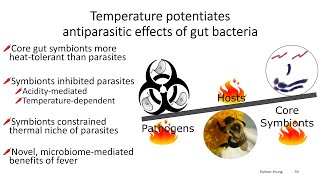
The study found that bumble bees infected with a parasite had significantly lower infection levels at higher temperatures (from 21°C to 37°C), and the peak infection temperatures were lower than expected based on parasite growth alone, indicating complex interactions.
The composition and size of gut bacterial communities in bees changed with temperature in non-linear ways, with some bacteria like Orbaceae and Enterobacteriaceae showing variable effects on infection depending on temperature, suggesting that gut bacteria activity influences disease resistance.
Overall, the research suggests that both host-parasite dynamics and gut bacteria responses to temperature are important for understanding infection resistance, which has broader implications for disease management in changing climates for ectothermic and endothermic animals.]
Temperature dependence of parasitic infection and gut bacterial communities in bumble bees. - Palmer-Young EC et al. - https://t.co/vhg1azSUGA #microbiome
Both gut microbiota and host temperature influence infection resistance in bumblebees. Higher temperatures reduce parasite levels, with complex interactions between gut bacteria and infection that vary across…
This study examines how higher temperatures reduce parasite infection levels in bumblebees and how gut bacterial communities respond to temperature, influencing disease resistance in changing climates.
Temperature dependence of parasitic infection and gut bacterial communities in bumble bees. - Palmer-Young EC et al. - https://t.co/vhg1azSUGA #microbiome
 MA
MA UE
UE AS
AS UC
UC
 JC
JC