Multiple posts praise the new method's utility, referencing collaborations with Johns Hopkins and Leuven, and noting its potential to improve ultrasound imaging techniques. The tone indicates excitement about its practical applications, with phrases like 'useful for researchers' and 'can be applied to various image types,' suggesting a positive outlook on influence and further research.
AgreementModerate agreement
Most posts highlight agreement with the publication, recognizing the importance of a more reliable measure like the generalized contrast-to-noise ratio for lesion detectability.
InterestHigh interest
Discussions show high interest, especially in its application to ultrasound imaging and potential to improve image analysis.
EngagementModerate engagement
Posts demonstrate engagement through mentions of collaborations and implications for researchers, though some are more informational than deeply analytical.
ImpactModerate impact
The discussions imply that the work could have a meaningful impact on imaging methodology, particularly in advancing ultrasound techniques and research tools.
Abstract in brief
The traditional contrast-to-noise ratio (CNR) used in ultrasound imaging is unreliable with modern beamforming techniques because it can give arbitrarily high values without reflecting true lesion detectability.
The authors introduce a new, generalized CNR (gCNR) based on the overlap of probability density functions, which is more stable, applicable to various image types, and provides a clear statistical meaning related to the success rate of lesion detection.
Testing on different imaging methods and image modifications shows that gCNR offers consistent and meaningful measurements of lesion detectability, fixing previous methodological issues and helping evaluate the effectiveness of new imaging algorithms.]
Together with @JohnsHopkins & @KU_Leuven, we have created a new method to measure contrast in #ultrasound images. This can be useful for researchers working on new or improved image formation methods for medical ultrasound and other imaging technologies. https://t.co/24NfdOR99G
May 8, 2020 · 4 likes · 1 share · 213 followersView post →
E
EurekaMag
@EurekaMag · X
The generalized contrast-to-noise ratio: a formal definition for lesion detectability https://t.co/XFaF37ueAy
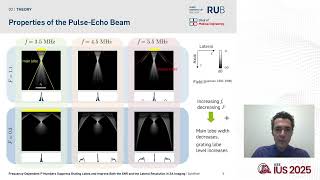
This presentation discusses how accounting for the frequency dependence of the Fnumber improves contrast and spatial resolution in ultrafast pulse-echo ultrasound imaging, featuring a closed-form Fnumber expression and…
This lecture examines how frequency-dependent F-numbers impact synthetic aperture ultrasound imaging, demonstrating how they suppress grating lobes and improve signal-to-noise ratio and lateral resolution. MATLAB and…
RT @CIUS_NTNU: Together with @JohnsHopkins & @KU_Leuven, we have created a new method to measure contrast in #ultrasound images. This can b…
Jun 14, 2020 · 1 share · 2,074 followersView post →
C
CIUS
@CIUS_NTNU · X
Together with @JohnsHopkins & @KU_Leuven, we have created a new method to measure contrast in #ultrasound images. This can be useful for researchers working on new or improved image formation methods for medical ultrasound and other imaging technologies. https://t.co/24NfdOR99G
May 8, 2020 · 4 likes · 1 share · 213 followersView post →
N
The Generalized Contrast-to-Noise Ratio A Formal Definition For ...
News
Digital Object Identifier 10.1109/TUFFC.2019.2956855 and the gCNR of the studied imaging methods is evaluated. This work is licensed under a Creative ...
 C
C E
E BB
BB SA
SA