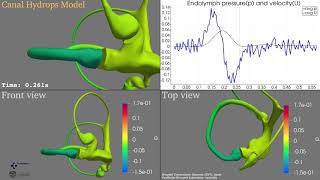
Several discussions praise the study for its innovative use of modeling to understand inner ear mechanics, such as mentions of using Blender for scientific modeling and suggestions that clinicians should interpret vHIT data carefully in Menière’s disease cases. The tone and specific references to technical tools and clinical relevance emphasize both curiosity and recognition of the study’s potential impact.
AgreementModerate agreement
Most discussions acknowledge the importance and novelty of the research, especially in understanding how hydrops can influence clinical assessments.
InterestHigh interest
Posts exhibit high curiosity about the application of modeling tools and clinical implications, indicating strong interest.
EngagementModerate engagement
Comments range from praise to suggestions for further research, reflecting moderate but meaningful engagement.
ImpactModerate impact
Discussions highlight the potential for this research to influence diagnostic techniques for Menière's disease, though the overall impact on practice is still emerging.
Abstract in brief
The study developed computational models of the vestibular system to analyze how endolymphatic hydrops (fluid buildup) might mechanically influence eye movement responses during head impulse tests, challenging the idea that increases in these responses are solely due to neurological issues.
Simulating different anatomical conditions (normal, canal hydrops, utricular hydrops), the models showed increased pressure in the semicircular canal region when hydrops were present, suggesting that fluid distension can enhance eye movement responses measured by the vestibulo-ocular reflex (VOR).
Results indicated that in hydrops conditions, eye velocity responses and VOR gains could be increased by approximately 11-14%, implying that abnormal eye movements observed in clinical tests might sometimes stem from mechanical effects of hydrops rather than purely neural dysfunction.
We thank to @simflow_cfd for its support to our last research, in which we used Simflow to study the inner ear fluid (endolymph) hydrodynamics on normal persons and Meniere Disease patients during a head impulse.
THANK YOU VERY MUCH !
Take a look at: https://t.co/zxLPxdhJZT
Apr 27, 2020 · 1 like · 1 share · 153 followersView post →
LM
Leonardo Manzari
@Leonard03324345 · X
Congratulations Ann on your newly published @FrontiersIn article: https://t.co/otXAsSa9DI
Could Blender software be used in scientific research?
Yes, of course that it can !
We successfully used blender to model Menière Disease (an inner ear disease).
Take a look at: https://t.co/zxLPxdhJZT
@tonroosendaal #meniere #research #blender
In some clinical moments we should see the vestibular hydrops on vHIT, we publish the biomechanics basis on: Computing Endolymph Hydrodynamics During Head Impulse Test on Normal and Hydropic Vestibular Labyrinth Models https://t.co/KrfsRxpxWO
This video examines computational models analyzing how fluid buildup in the vestibular system influences eye movements during head impulse tests, highlighting mechanical effects of hydrops on vestibulo-ocular reflex…
This research analyzes how fluid buildup in the vestibular system influences eye movement responses during head impulse tests, suggesting that mechanical factors in hydrops can elevate VOR responses, potentially…
We thank to @simflow_cfd for its support to our last research, in which we used Simflow to study the inner ear fluid (endolymph) hydrodynamics on normal persons and Meniere Disease patients during a head impulse.
THANK YOU VERY MUCH !
Take a look at: https://t.co/zxLPxdhJZT
Apr 27, 2020 · 1 like · 1 share · 153 followersView post →
CL
Computing the labyrinth
@AudCal_app · X
Could Blender software be used in scientific research?
Yes, of course that it can !
We successfully used blender to model Menière Disease (an inner ear disease).
Take a look at: https://t.co/zxLPxdhJZT
@tonroosendaal #meniere #research #blender
In some clinical moments we should see the vestibular hydrops on vHIT, we publish the biomechanics basis on: Computing Endolymph Hydrodynamics During Head Impulse Test on Normal and Hydropic Vestibular Labyrinth Models https://t.co/KrfsRxpxWO
 CL
CL LM
LM S
S