The discussions highlight the significance of the new Δ metric for evaluating MOF performance, with posters expressing interest in its ability to optimize mixture separations. Words like 'important,' 'innovative,' and phrases such as 'revolutionize separation processes' demonstrate how the tone emphasizes the article's potential impact on future technologies and research directions.
AgreementModerate agreement
Most discussions acknowledge the relevance and importance of the article's focus on MOFs and their evaluation metrics.
InterestHigh interest
Posts show high curiosity about the new separation metric and its potential applications, indicating strong engagement.
EngagementModerate engagement
Comments often reference specific concepts like adsorption selectivity and diffusion, reflecting thoughtful consideration.
ImpactModerate impact
Participants recognize the article's potential influence on future research and practical separation processes in industry.
Abstract in brief
Metal-organic frameworks (MOFs) are critical for mixture separations in fixed bed adsorption devices using pressure swing adsorption (PSA) technology, which cycles through adsorption and desorption phases.
The effectiveness of MOFs is influenced by several factors including adsorption selectivity, uptake capacities, diffusion characteristics, and the ability to regenerate after use.
A new metric, Δ, known as separation potential, helps evaluate MOF performance by measuring the maximum productivity achieved in the adsorption or desorption cycles, and it explores the potential to manipulate diffusion limitations for enhanced selectivity, such as capturing nitrogen from natural gas.
In this latest #Perspective @ACS_Omega, Rajamani Krishna @UvA_Amsterdam discusses #metrics for evaluation and screening of metal–organic frameworks for applications in mixture separations @MOF_papers https://t.co/WzbVP5jbn2
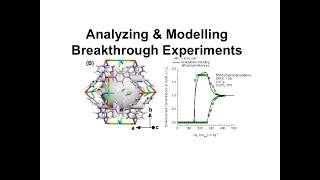
This video explores the simulation of breakthrough experiments for the selective separation of propyne-propadiene mixtures, highlighting novel MOF materials for efficient separation and how modeling aligns with…
This video discusses metrics for evaluating MOFs in mixture separations using PSA technology, focusing on selectivity, uptake capacities, and the separation potential metric to improve screening and performance analysis…
This presentation explores how intracrystalline diffusivities influence separation performance in microporous materials like MOFs and zeolites, focusing on diffusion-driven effects that can enhance or reverse…
This video explores the challenge of separating propyne and propadiene in the petrochemical industry, highlighting a novel metalorganic framework with record productivity, and discusses how simulations align with…
This video discusses the use of Cogallate pellets for C2H4C2H6 separation, highlighting diffusional influences that are stronger at industrial scale despite using same-sized pellets. It emphasizes the importance of…
For production of alkene feedstocks of 99.95% purity required for polymerization reactors cryogenic distillation columns are employed for large scale separations of C2H4C2H6 and C3H6C3H8 mixtures. New MOF developments…
This video discusses the traditional cryogenic distillation methods for purifying alkene feedstocks, focusing on C2H4 and C2H6 separation. It highlights current challenges and the potential of metal-organic frameworks…
This video discusses the challenges of separating ethyne C2H2 from CO2 due to their similar properties and highlights a novel sulfate-pillared MOF, SOFOURTEPEZn, designed for efficient separation using dense…
This presentation discusses kinetically driven separations of C3H6/C3H8 mixtures using ZIF8, focusing on crystal size and contact times. It highlights the concept of optimal crystal sizes for effective separation based…
This presentation discusses the use of C3H6C3H8 separation using CHA zeolite through simulations analyzing contact times and diffusional influences on separation efficiency, emphasizing the impact of diffusional time…
This video examines C3H6C3H8 separations with pressure swing adsorption (PSA) using C3H8 selective adsorbents NiADCTED05 and CAU3BDC, focusing on their effectiveness for high-purity propylene separation based on recent…
This presentation discusses kinetically driven separation of C3H6 and C3H8 in ZIF-8, emphasizing the impact of crystal size and contact time on separations. Key insights include optimal crystal size and diffusion…
This presentation discusses kinetically driven separations of C3H6/C3H8 mixtures using ZIF8, focusing on how crystal size and contact times influence separation efficiency, highlighting the concept of optimal crystal…
This presentation discusses kinetically driven separations of C3H6C3H8 mixtures using CHA zeolite, focusing on how crystal size and contact times influence diffusional effects essential for mixture separation efficiency.
In steam cracking of ethane to produce ethene, one byproduct is ethyne, which can negatively impact polymer production. Effective separation techniques, including MOFs and advanced porous materials, are essential for…
In this latest #Perspective @ACS_Omega, Rajamani Krishna @UvA_Amsterdam discusses #metrics for evaluation and screening of metal–organic frameworks for applications in mixture separations @MOF_papers https://t.co/WzbVP5jbn2