Nanotechnology Papers
@NanotechPapers · X
Random Forest Models for Accurate Identification of Coordination Environments from X-ray Absorption Near-Edge Structure. https://t.co/LCE2eTOa4o
Nov 5, 2019 · 4,314 followers
View post →
Mentions
Extended reach
Total likes
Video views
AI synopsis
The discussions reflect a positive reception, with users noting the innovative use of random forest models in spectral analysis, exemplified by phrases like 'accurately identify coordination environments' and 'more detailed understanding.' The tone is both curious and appreciative, emphasizing the scientific and practical significance of the research.
Most discussions recognize the value of combining machine learning with XANES analysis, indicating general support for the publication's approach.
Posts show moderate curiosity, with some exploring the technical aspects and potential applications of the models.
Many comments refer to specific methods and discuss implications, suggesting a decent level of engagement.
Discussions highlight the potential for these models to influence future research and practical analysis in material sciences.
Random Forest Models for Accurate Identification of Coordination Environments from X-ray Absorption Near-Edge Structure. https://t.co/LCE2eTOa4o
XAS也要結合Machine Learning是吧...? High Throughput XAS Calculations and Machine Learning: XAS Journal Club,... https://t.co/9w8fhnMw48 via @YouTube

Dr Chi Chen discusses high-throughput computation and machine learning models that enhance the interpretation of XAS spectra, focusing on their ability to accurately identify atomic coordination environments in…
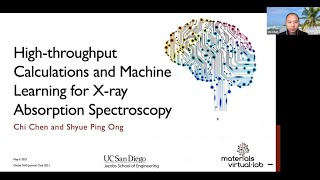
This seminar introduces the high-throughput calculation workflow for creating the XASDb database. It highlights the development of machine learning models, particularly random forest classifiers, for accurately…

Prof Ong discusses recent advances in using machine learning models, trained on large X-ray absorption spectra databases, to accurately identify atomic coordination environments, including application demos and model…
XAS也要結合Machine Learning是吧...? High Throughput XAS Calculations and Machine Learning: XAS Journal Club,... https://t.co/9w8fhnMw48 via @YouTube
Random Forest Models for Accurate Identification of Coordination Environments from X-ray Absorption Near-Edge Structure. https://t.co/LCE2eTOa4o