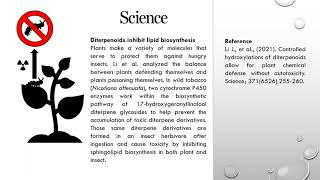
The discussions consistently praise the research for revealing how plants utilize controlled hydroxylation to balance defense and self-protection, with phrases like 'great teamwork' and 'plants are so smart' reflecting both admiration and recognition of the study's significance. The tone, emphasizing 'proven', 'elucidate', and 'delighted to share', demonstrates enthusiasm and acknowledgment of the research's impactful nature.
AgreementStrong agreement
Most discussions highlight the significance of the research, calling it a 'game changer' and emphasizing the clever biological mechanisms involved.
InterestHigh interest
The widespread sharing and praise indicate high curiosity and relevance among followers about plant defense and biochemical processes.
EngagementHigh engagement
Many posts reference specific aspects like biosynthesis pathways, gene silencing effects, and the potential applications, suggesting deep thinking and interaction.
ImpactHigh impact
Repeated mentions of the study's importance and mentions of it as a 'discovery' or 'proving how smart plants are' show a perception of high influence on scientific understanding and potential agricultural benefits.
Abstract in brief
Controlling hydroxylation in diterpenoid biosynthesis in plants allows them to defend against herbivores without harming themselves by preventing autotoxicity.
Silencing key enzymes in this pathway leads to harmful effects because it disrupts sphingolipid production, which is crucial for plant health, caused by improperly hydroxylated diterpene derivatives.
The plant's defense mechanism involves producing hydroxylated diterpenes after herbivore ingestion, which then inhibit herbivore sphingolipid synthesis, illustrating a sophisticated balance between chemical defense and self-protection.]
Great team work with Jiancai Li and other co-authors at @MPI_CE. I am delighted to share this paper published today: Controlled hydroxylations of diterpenoids allow for plant chemical defense without autotoxicity https://t.co/iFpHIrei1j
Jan 14, 2021 · 47 likes · 11 shares · 207 followersView post →
TN
Tatsuya Nobori
@nobolly · X
Controlled hydroxylations of diterpenoids allow for plant chemical defense without autotoxicity | Science https://t.co/5E4T4rqIqW
Jan 22, 2021 · 29 likes · 6 shares · 8,228 followersView post →
KL
Kampranis Lab
@KampranisLab · X
Once again plants are proven to be so smart! they manage to control not only their biochemistry but the biochemistry of their enemies!
Controlled hydroxylations of diterpenoids allow for plant chemical defense without autotoxicity https://t.co/7bf4f3GbHP
Jan 24, 2021 · 6 likes · 2 shares · 1,087 followersView post →
IS
Islam S. Sobhy
@IslamSSobhy_78 · X
Controlled hydroxylations of diterpenoids allow for plant chemical defense without autotoxicity https://t.co/yHzCmTY77s
Jan 30, 2021 · 5 likes · 1 share · 1,226 followersView post →
C
ChemBioSys
@chembiosys_jena · X
New publication by the Baldwin lab in Science: How plants produce defensive toxins without harming themselves
https://t.co/oZ10Hakgmz
https://t.co/UZ91qqR1fD
Defense and autotoxicity: Researchers elucidate the biosynthesis and mode of action of diterpene glycosides in wild tobacco @ScienceMagazine @MPI_CE https://t.co/UgRmrUQtuk & https://t.co/AFZ6aW5i3Y
Jan 15, 2021 · 4 likes · 2 shares · 20,211 followersView post →
This video highlights the role of endoplasmic reticulum stress (ERS) in insulin resistance associated with obesity. It explores how increased connexin 43 (Cx43) in liver cells facilitates intercellular communication…
We brought to you ‘Weekly Scientific Reports’ highlighting critical studies in top journals. This week focuses on the alarming decline of insect populations due to habitat loss and climate change and emphasizes the…
RT @WWU_Muenster: Defense and autotoxicity: Researchers elucidate the biosynthesis and mode of action of diterpene glycosides in wild tobac…
Jun 26, 2021 · 2 shares · 152 followersView post →
と
とりさん
@biochem_fan · X
Science "Controlled hydroxylations of diterpenoids allow for plant chemical defense without autotoxicity" https://t.co/Bam7mZiOwb
植物と昆虫で共通する sphingolipid 代謝経路を阻害する毒素なのに、なぜ、それを合成する植物自体は中毒しないのかという話。
Jun 25, 2021 · 1 like · 6,038 followersView post →
CR
Christelle AM Robert
@CAM_Robert_Bern · X
RT @shuqing_xu: Great team work with Jiancai Li and other co-authors at @MPI_CE. I am delighted to share this paper published today: Contro…
Mar 19, 2021 · 11 shares · 1,324 followersView post →
L
lepidopapers
@lepido_papers · X
Controlled hydroxylations of diterpenoids allow for plant chemical defense without autotoxicity. https://t.co/6wevOAQmnC
RT @IslamSSobhy_78: Controlled hydroxylations of diterpenoids allow for plant chemical defense without autotoxicity https://t.co/yHzCmTY77s
Jan 30, 2021 · 1 share · 3,660 followersView post →
IS
Islam S. Sobhy
@IslamSSobhy_78 · X
Controlled hydroxylations of diterpenoids allow for plant chemical defense without autotoxicity https://t.co/yHzCmTY77s
Jan 30, 2021 · 5 likes · 1 share · 1,226 followersView post →
IE
International Society of Chemical Ecology
@ChemEcol_org · X
RT @shuqing_xu: Great team work with Jiancai Li and other co-authors at @MPI_CE. I am delighted to share this paper published today: Contro…
Jan 26, 2021 · 11 shares · 2,017 followersView post →
H
HOPE
@HOPE_NNF · X
RT @KampranisLab: Once again plants are proven to be so smart! they manage to control not only their biochemistry but the biochemistry of t…
Jan 24, 2021 · 2 shares · 160 followersView post →
SK
Sotirios Kampranis
@s_kampranis · X
RT @KampranisLab: Once again plants are proven to be so smart! they manage to control not only their biochemistry but the biochemistry of t…
Jan 24, 2021 · 2 shares · 810 followersView post →
KL
Kampranis Lab
@KampranisLab · X
Once again plants are proven to be so smart! they manage to control not only their biochemistry but the biochemistry of their enemies!
Controlled hydroxylations of diterpenoids allow for plant chemical defense without autotoxicity https://t.co/7bf4f3GbHP
Jan 24, 2021 · 6 likes · 2 shares · 1,087 followersView post →
RH
RTNakanoLab Hokudai
@rtnakano_lab · X
RT @nobolly: Controlled hydroxylations of diterpenoids allow for plant chemical defense without autotoxicity | Science https://t.co/5E4T4rq…
Jan 24, 2021 · 6 shares · 612 followersView post →
BK
Brian Kvitko
@KvitkoPhD · X
RT @nobolly: Controlled hydroxylations of diterpenoids allow for plant chemical defense without autotoxicity | Science https://t.co/5E4T4rq…
Jan 23, 2021 · 6 shares · 1,413 followersView post →
MA
Mohammed Asad
@Mohammedlion130 · X
RT @nobolly: Controlled hydroxylations of diterpenoids allow for plant chemical defense without autotoxicity | Science https://t.co/5E4T4rq…
RT @nobolly: Controlled hydroxylations of diterpenoids allow for plant chemical defense without autotoxicity | Science https://t.co/5E4T4rq…
Jan 23, 2021 · 6 shares · 5,567 followersView post →
J魏
Jin-Wei Wei|魏金伟
@JinWeiWEi6 · X
RT @nobolly: Controlled hydroxylations of diterpenoids allow for plant chemical defense without autotoxicity | Science https://t.co/5E4T4rq…
Jan 23, 2021 · 6 shares · 151 followersView post →
TN
Tatsuya Nobori
@nobolly · X
Controlled hydroxylations of diterpenoids allow for plant chemical defense without autotoxicity | Science https://t.co/5E4T4rqIqW
Jan 22, 2021 · 29 likes · 6 shares · 8,228 followersView post →
C
ChemBioSys
@chembiosys_jena · X
New publication by the Baldwin lab in Science: How plants produce defensive toxins without harming themselves
https://t.co/oZ10Hakgmz
https://t.co/UZ91qqR1fD
This plant accumulates compounds that damage pest insects when ingested, but the plant itself maintains a detoxifying pathway to avoid poisoning itself.
Controlled hydroxylations of diterpenoids allow for plant chemical defense without autotoxicity https://t.co/kFNBQA6GX0
Jan 19, 2021 · 2 likes · 1,600 followersView post →
AC
ANTIBIOTIC CellMAP
@TRR261 · X
Controlled hydroxylations of diterpenoids allow for plant chemical defense without autotoxicity! By Ian Baldwin and coworkers @MPI_CE
https://t.co/MqaQFRfmC5
RT @shuqing_xu: Great team work with Jiancai Li and other co-authors at @MPI_CE. I am delighted to share this paper published today: Contro…
Jan 15, 2021 · 11 shares · 614 followersView post →
GC
Guillaume Chomicki
@Chomicki_G · X
RT @shuqing_xu: Great team work with Jiancai Li and other co-authors at @MPI_CE. I am delighted to share this paper published today: Contro…
Jan 15, 2021 · 11 shares · 1,416 followersView post →
UM
Universität Münster
@uni_muenster · X
Defense and autotoxicity: Researchers elucidate the biosynthesis and mode of action of diterpene glycosides in wild tobacco @ScienceMagazine @MPI_CE https://t.co/UgRmrUQtuk & https://t.co/AFZ6aW5i3Y
Jan 15, 2021 · 4 likes · 2 shares · 20,211 followersView post →
PV
Philip Vollet
@philipvollet · X
RT @shuqing_xu: Great team work with Jiancai Li and other co-authors at @MPI_CE. I am delighted to share this paper published today: Contro…
Jan 15, 2021 · 11 shares · 30,867 followersView post →
RN
Roy Nakbayaski
@Digging_Plants · X
RT @shuqing_xu: Great team work with Jiancai Li and other co-authors at @MPI_CE. I am delighted to share this paper published today: Contro…
Jan 15, 2021 · 11 shares · 742 followersView post →
PS
Phil @wigge.bsky.social
@PhilWigge · X
RT @shuqing_xu: Great team work with Jiancai Li and other co-authors at @MPI_CE. I am delighted to share this paper published today: Contro…
Jan 15, 2021 · 11 shares · 3,484 followersView post →
NM
Nachelli Malpica
@NachelliM · X
RT @shuqing_xu: Great team work with Jiancai Li and other co-authors at @MPI_CE. I am delighted to share this paper published today: Contro…
Jan 15, 2021 · 11 shares · 74 followersView post →
EB
Eli James Borrego
@elijborrego · X
RT @shuqing_xu: Great team work with Jiancai Li and other co-authors at @MPI_CE. I am delighted to share this paper published today: Contro…
Jan 14, 2021 · 11 shares · 411 followersView post →
TC
Tristan M. Cofer
@tristancofer · X
RT @shuqing_xu: Great team work with Jiancai Li and other co-authors at @MPI_CE. I am delighted to share this paper published today: Contro…
Jan 14, 2021 · 11 shares · 243 followersView post →
ME
Matthias Erb
@Matthias__Erb · X
RT @shuqing_xu: Great team work with Jiancai Li and other co-authors at @MPI_CE. I am delighted to share this paper published today: Contro…
Jan 14, 2021 · 11 shares · 1,887 followersView post →
XS
Xu Shuqing
@shuqing_xu · X
Great team work with Jiancai Li and other co-authors at @MPI_CE. I am delighted to share this paper published today: Controlled hydroxylations of diterpenoids allow for plant chemical defense without autotoxicity https://t.co/iFpHIrei1j
Jan 14, 2021 · 47 likes · 11 shares · 207 followersView post →