The overall discussions show a cautious optimism, with remarks like 'some response is promising' and questions about the variability in scores, reflecting engagement with both the data and its implications. The tone balances interest with critical consideration of the findings' real-world relevance.
AgreementModerate agreement
Most users seem to agree that the research shows promising results, with some noting similar findings from their own studies.
InterestModerate interest
Discussions demonstrate moderate curiosity, particularly about how results translate to real-world settings and the variations in patient responses.
EngagementModerate engagement
Participants reference specific data points, such as the 54% response rate and 29% remission, indicating a moderate level of engagement with the content.
ImpactModerate impact
The discussions highlight potential impacts on clinical practices and the importance of understanding patient variability, suggesting a meaningful, though not transformative, influence.
Abstract in brief
A large retrospective study of 9,016 depression patients across 178 U.S. clinics found that ketamine intravenous therapy (KIT) significantly reduced depression symptoms, with about 99.8% of patients responding positively after induction treatment.
Most patients maintained their antidepressant response for several weeks, with an 80% chance of sustained response at 4 weeks and 60% at 8 weeks, even without ongoing infusions.
While KIT was generally effective, a small percentage of patients experienced worsening symptoms, and effects were slightly stronger in more severely depressed individuals, but overall response rates were consistent regardless of initial depression severity.]
@ferenstein We saw something similar in a study we did https://t.co/XFFoK5KYLB One thing I wondered - given that PHQ scores will vary from day to day, how do you interpret a worse score on a retest? Some proportion will score worse with the same symptoms.
Aug 22, 2024 · 2 likes · 3,472 followersView post →
B
Blossom
@blossomact · X
Of the patients, 54% showed a response (<50% on PHQ-9), 29% met the more stringent criteria of remission (<5 PHQ-9 score)
Though for about 9% there was an increase in depressive symptoms
https://t.co/ECrKWwJ5n4 3/9
1) Poster Presentation:
Title: A Retrospective Analysis of Ketamine Intravenous Therapy for PTSD in Real-World Care Settings
Date & Time: Thursday, 1/23, 6:00 PM – 7:30 PM
Location: Moontower Hall
Speaker: Dr. L. Alison McInnes MD, MS, Osmind’s VP of Scientific Affairs
1) A Retrospective Analysis of Ketamine Intravenous Therapy for PTSD in Real-World Care SettingsLed by Rob Berman, M.D. (Yale University, Osmind Strategic Advisor) & L. Alison McInnes MD, MS McInnes, M.D., MS (VP of Scientific Affairs, Osmind)
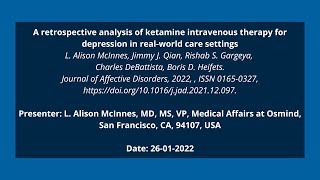
A retrospective analysis of ketamine intravenous therapy for depression in real-world care settings. The study examined 9,016 patients, finding significant symptom reduction and sustained responses up to 8 weeks without…
Dr. Tiago explains how ketamine acts on the brain by blocking NMDA receptors and increasing neurotransmitters like glutamate, leading to enhanced synaptic connections. This multifaceted activity underpins its…
1) Poster Presentation:
Title: A Retrospective Analysis of Ketamine Intravenous Therapy for PTSD in Real-World Care Settings
Date & Time: Thursday, 1/23, 6:00 PM – 7:30 PM
Location: Moontower Hall
Speaker: Dr. L. Alison McInnes MD, MS, Osmind’s VP of Scientific Affairs
1) A Retrospective Analysis of Ketamine Intravenous Therapy for PTSD in Real-World Care SettingsLed by Rob Berman, M.D. (Yale University, Osmind Strategic Advisor) & L. Alison McInnes MD, MS McInnes, M.D., MS (VP of Scientific Affairs, Osmind)
@ferenstein We saw something similar in a study we did https://t.co/XFFoK5KYLB One thing I wondered - given that PHQ scores will vary from day to day, how do you interpret a worse score on a retest? Some proportion will score worse with the same symptoms.
Aug 22, 2024 · 2 likes · 3,472 followersView post →
B
Blossom
@blossomact · X
Of the patients, 54% showed a response (<50% on PHQ-9), 29% met the more stringent criteria of remission (<5 PHQ-9 score)
Though for about 9% there was an increase in depressive symptoms
https://t.co/ECrKWwJ5n4 3/9