The discussions reflect a positive outlook on the new synthesis method, with mentions of its potential for simplifying peptide production and expanding applications, exemplified by phrases like 'easy access to crude peptides' and references to 'broader applicability.' The tone is generally supportive and curious, emphasizing the innovation's practical advantages and including personal acknowledgments such as 'happy to have my contribution published.'
AgreementModerate agreement
Most comments express positive acknowledgment of the technique and its benefits, such as its simplicity and potential for broad applicability.
InterestHigh interest
The discussions indicate high curiosity about the method, especially in terms of synthesis efficiency and scalability.
EngagementModerate engagement
The posts show some interaction with the research, particularly through sharing personal reactions and mentioning implications, though not overwhelmingly deep.
ImpactModerate impact
The shared enthusiasm suggests the method could influence peptide synthesis practices, but the discussions remain relatively preliminary and accessible.
Abstract in brief
The text describes a method for synthesizing thiol-functionalized peptides using solid-phase peptide synthesis on a disulfide linker resin, followed by a reductive release process that avoids traditional chromatographic purification.
This approach allows the production of high-purity peptides (around 90%) without the need for laborious and costly chromatographic steps, making it suitable for large-scale peptide library production.
The method enables parallel synthesis and direct cyclization of peptides with multiple thiol groups, facilitating the creation of peptide libraries, including cyclic peptides, through biselectrophilic alkylation.
Happy to have my first Heinis lab contribution published in @OrgBiomolChem
Here we developed a reductive release method to provide easy access to crude peptides in good purity using 1,4-butanedithiol as a volatile reducing agent.
https://t.co/DoTwHXnwRJ
Solid-phase peptide synthesis on disulfide-linker resin followed by reductive release affords pure thiol-functionalized peptides
https://t.co/OdJjxu3pFb https://t.co/AuWANV8Vv7
This work focused on diversification of dithioether macrocycles (for synthesis workflow, see https://t.co/FJD7of0OFc…). However, this method should be generally applicable to a wide range of linear and cyclic peptides.
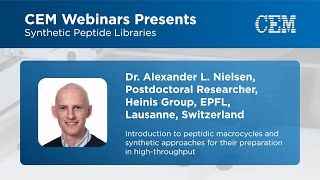
Learn about CEM's peptide synthesis solutions and high-throughput methods for creating and screening macrocyclic peptide libraries using robotic automation and acoustic dispensing.
Learn about CEMs peptide synthesis solutions including robotic automation and acoustic dispensing for high-throughput screening of macrocyclic peptides.
This work focused on diversification of dithioether macrocycles (for synthesis workflow, see https://t.co/FJD7of0OFc…). However, this method should be generally applicable to a wide range of linear and cyclic peptides.
Solid-phase peptide synthesis on disulfide-linker resin followed by reductive release affords pure thiol-functionalized peptides
https://t.co/OdJjxu3pFb https://t.co/AuWANV8Vv7
Happy to have my first Heinis lab contribution published in @OrgBiomolChem
Here we developed a reductive release method to provide easy access to crude peptides in good purity using 1,4-butanedithiol as a volatile reducing agent.
https://t.co/DoTwHXnwRJ