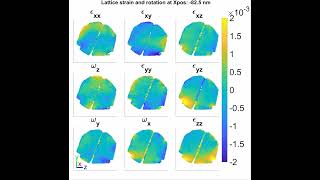
David Yang et al.: Refinements for Bragg coherent X-ray diffraction imaging: electron backscatter diffraction alignment and strain field computation #StrainCalculation ... #IUCr https://t.co/kqwSAaWPwc
Refinements for Bragg coherent X-ray diffraction imaging: electron backscatter diffraction alignment and strain field computation.
Mentions
Extended reach
Total likes
Video views
Mentions per month
Mar 2022 – Jan 2023Where it's discussed
-
YouTube3 videos
-
X / Twitter2 posts
AI synopsis
What people are saying
The discussions reflect a positive reception emphasizing the technical sophistication of the improvements, with phrases like 'refinements for better accuracy' and 'enhanced approach' indicating perceived value. The tone suggests appreciation for the potential impact on material science research, especially in microcrystal analysis.
Most discussions acknowledge the technical improvements and significance of the refined methods in BCDI, indicating general agreement.
Posts show a high level of interest in the methodological advancements and applications, using technical language and highlighting the importance of precise strain measurements.
Several posts reference specific aspects of the study, such as the calibration of EBSD Euler angles and better strain calculations, demonstrating they are engaging deeply with the material.
Participants consider the research influential, mentioning its potential to enhance microcrystal analysis and improve the accuracy and efficiency of strain field measurements.
Abstract in brief
- This text discusses improvements in Bragg coherent X-ray diffraction imaging (BCDI), focusing on how to better determine crystal orientation using electron backscatter diffraction (EBSD), which helps in accurately measuring strain fields within microcrystals.
- The new method involves calculating the crystal orientation from EBSD Euler angles and comparing it with traditional Laue diffraction results, showing a small mismatch and demonstrating that EBSD can effectively prealign samples for BCDI measurements.
- The study presents an enhanced approach for computing strain fields that accounts for dislocations, leading to more precise results, and confirms that using EBSD for sample alignment can increase the efficiency and accuracy of 3D lattice strain measurements in microcrystals.]
Top posts
Most liked on X and Bluesky[2203.17015] David Yang, Mark T. Lapington, Guanze He et al.: Refinements for Bragg coherent X-ray diffraction imaging: Electron backscatter diffraction alignment and strain field computation https://t.co/nZyJunPJXc https://t.co/ZIzbty9if8 #cond_mat_mtrl_sci
All mentions
Enhancing BCDI with Electron Backscatter Diffraction Alignment Techniques
This video discusses advancements in Bragg coherent X-ray diffraction imaging (BCDI), focusing on using electron backscatter diffraction (EBSD) for precise crystal orientation determination to improve strain field…
Enhanced BCDI Alignment Using Electron Backscatter Diffraction Data
This video discusses improvements in Bragg coherent X-ray diffraction imaging, focusing on better crystal orientation determination with electron backscatter diffraction to improve strain field measurements in…
Enhanced Alignment Techniques for Bragg Coherent X-ray Diffraction Imaging
This video discusses improvements in BCDI, focusing on using electron backscatter diffraction (EBSD) for crystal orientation determination to improve strain field measurements in microcrystals.
David Yang et al.: Refinements for Bragg coherent X-ray diffraction imaging: electron backscatter diffraction alignment and strain field computation #StrainCalculation ... #IUCr https://t.co/kqwSAaWPwc
[2203.17015] David Yang, Mark T. Lapington, Guanze He et al.: Refinements for Bragg coherent X-ray diffraction imaging: Electron backscatter diffraction alignment and strain field computation https://t.co/nZyJunPJXc https://t.co/ZIzbty9if8 #cond_mat_mtrl_sci