The discussions demonstrate high agreement, as posts consistently support the idea that social interactions benefit gut bacteria, with phrases like 'healthier gut microbiome' and 'beneficial microbes,' emphasizing the study's relevance. Interest is evidenced by mentions of specific bacteria such as 'Faecalibacterium' and the health benefits of friendships, while some posts speculate on broader applications, reinforcing an overall perception of high impact.
AgreementStrong agreement
Most discussions express strong support and validation of the study’s findings, emphasizing the positive correlation between social behaviors and gut health.
InterestHigh interest
Participants show high curiosity by discussing specific bacteria, health implications, and the social behavior aspects highlighted in the research.
EngagementModerate engagement
Many discussions reference the study directly, mentioning key concepts like microbiomes and sociability, but few go into detailed critique or exploration, indicating moderate depth.
ImpactHigh impact
The collective tone suggests this research is perceived as meaningful, with several posts highlighting its implications for understanding health and behavior in primates and potentially humans.
Abstract in brief
The study reveals that in wild rhesus macaques, variations in social behaviors like grooming are linked to differences in specific gut bacteria, some of which are known to promote health and reduce inflammation.
Certain bacteria associated with higher sociability are beneficial, while bacteria linked to less social individuals tend to include pathogenic species, suggesting a connection between social interactions, gut microbiome, and health.
The findings highlight a reciprocal relationship where social behavior influences gut bacteria, which in turn can impact immune health, emphasizing the interconnectedness of sociality, microbiome, and well-being in primates.]
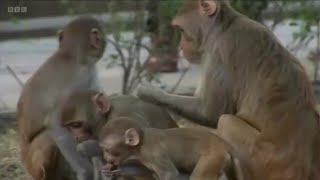
Researchers show for the first time that monkeys that are more sociable - eg, grooming or being groomed more often - have a healthier gut microbiome.
Read the study in @FrontMicrobiol by @DrKatJohnson and colleagues: https://t.co/0lNFBPoL0W or our news story ⬇
Nov 14, 2022 · 285 likes · 86 shares · 90,043 followersView post →
CP
Carol Perelman
@carol_perelman · X
Nov 19, 2022 · 39 likes · 8 shares · 25,971 followersView post →
PO
Phys.org
@physorg_com · X
Having good friendships may make for a healthier #gutmicrobiome @frontiersin @frontiersin https://t.co/KImejrIyzV https://t.co/elk0vdDeqt
Nov 11, 2022 · 23 likes · 5 shares · 1,016,857 followersView post →
F
Frontiers
@FrontiersIn · X
Researchers show for the first time that monkeys that are more sociable - eg, grooming or being groomed more often - have a healthier gut microbiome.
Read the study in @FrontMicrobiol by @DrKatJohnson and colleagues: https://t.co/0lNFBPoL0W or our news story ⬇
Jan 10, 2023 · 10 likes · 5 shares · 90,043 followersView post →
BI
Biocodex Microbiota Institute
@Microbiota_Inst · X
A @FrontMicrobiol study on non-captive #macaque "highlights the connections between #SocialBehaviour, #microbiome composition, and #health in an #animal population."
#microbiota #GutMicrobiota #GutBacteria #GutBrainAxis #sociability
@DrKatJohnson
Dec 1, 2022 · 7 likes · 4 shares · 26,791 followersView post →
KJ
Katerina Johnson
@DrKatJohnson · X
More sociable #macaques have more beneficial #gut #microbes like #Faecalibacterium known to be anti-inflammatory
Nov 11, 2022 · 6 likes · 3 shares · 738 followersView post →
Scientists explore how microbiomes can be transmitted through social networks, affecting health and disease development, including conditions like obesity and inflammatory diseases. Social microbial transfer may impact…
News feature Nov 2022 about my published research on healthier bacteria in sociable monkeys. The study links social behaviors like grooming to beneficial gut bacteria, highlighting how social interactions influence…
RT @FrontiersIn: Researchers show for the first time that monkeys that are more sociable - eg, grooming or being groomed more often - have…
Jan 10, 2023 · 5 shares · 526 followersView post →
FM
Frontiers - Microbiology
@FrontMicrobiol · X
RT @FrontiersIn: Researchers show for the first time that monkeys that are more sociable - eg, grooming or being groomed more often - have…
Jan 10, 2023 · 5 shares · 24,455 followersView post →
F
Frontiers
@FrontiersIn · X
Researchers show for the first time that monkeys that are more sociable - eg, grooming or being groomed more often - have a healthier gut microbiome.
Read the study in @FrontMicrobiol by @DrKatJohnson and colleagues: https://t.co/0lNFBPoL0W or our news story ⬇
Jan 10, 2023 · 10 likes · 5 shares · 90,043 followersView post →
Good friendship and gut health are closely connected.
Frontiers | Sociability in a non-captive macaque population is associated with beneficial gut bacteria https://t.co/NVNPMoSqNF
Friendly monkeys have higher levels of helpful bacteria and lower levels of potentially disease-causing microbes in their guts
Sociability in a non-captive macaque population is associated with beneficial gut bacteria https://t.co/HNzQEziqVx
A @FrontMicrobiol study on non-captive #macaque "highlights the connections between #SocialBehaviour, #microbiome composition, and #health in an #animal population."
#microbiota #GutMicrobiota #GutBacteria #GutBrainAxis #sociability
@DrKatJohnson
Dec 1, 2022 · 7 likes · 4 shares · 26,791 followersView post →
OP
Oxford Psychiatry
@OxPsychiatry · X
Sociability in a non-captive macaque population is associated with beneficial gut bacteria https://t.co/rZXa4omS3q
Nov 28, 2022 · 1 like · 1 share · 22,050 followersView post →
CC
Caribbean Primate Research Center
@CayoSantiagoPR · X
RT @NIH_ORIP: READ: "Sociability in a non-captive macaque population is associated with beneficial gut bacteria." @DrKatJohnson and collea…
New Research: Sociability in a non-captive macaque population is associated with beneficial gut bacteria https://t.co/b54qmDKRDI #microbiology
Nov 24, 2022 · 1 like · 1 share · 24,455 followersView post →
NO
NIH ORIP
@NIH_ORIP · X
READ: "Sociability in a non-captive macaque population is associated with beneficial gut bacteria." @DrKatJohnson and colleagues (ORIP support to the Caribbean Primate Research Center P40OD012217) #microbiome #gutbacteria #microbiota https://t.co/DC2k69tip5 https://t.co/q4D66AV1jR
Nov 23, 2022 · 3 likes · 1 share · 1,288 followersView post →
K
Katrin
@K2atrin · X
RT @FrontiersIn: Researchers show for the first time that monkeys that are more sociable - eg, grooming or being groomed more often - have…
Nov 22, 2022 · 86 shares · 296 followersView post →
FM
Frontiers - Microbiology
@FrontMicrobiol · X
RT @FrontiersIn: Researchers show for the first time that monkeys that are more sociable - eg, grooming or being groomed more often - have…
Nov 22, 2022 · 2 shares · 24,455 followersView post →
F
Frontiers
@FrontiersIn · X
Researchers show for the first time that monkeys that are more sociable - eg, grooming or being groomed more often - have a healthier gut microbiome.
Read the study in @FrontMicrobiol by @DrKatJohnson and colleagues: https://t.co/0lNFBPoL0W or our news story ⬇
Nov 22, 2022 · 5 likes · 2 shares · 90,043 followersView post →
LR
Lord & Lady Muk Raking.
@IIreckon · X
RT @FrontiersIn: Researchers show for the first time that monkeys that are more sociable - eg, grooming or being groomed more often - have…
Nov 21, 2022 · 86 shares · 4,862 followersView post →
RC
Robyn Connery
@robynconnery1 · X
RT @FrontiersIn: Researchers show for the first time that monkeys that are more sociable - eg, grooming or being groomed more often - have…
Nov 21, 2022 · 86 shares · 3,761 followersView post →
M
Merche
@more_49 · X
RT @carol_perelman:
Nov 20, 2022 · 8 shares · 415 followersView post →
AI
Arely Ireta
@ArelyIreta · X
RT @carol_perelman:
Nov 19, 2022 · 8 shares · 264 followersView post →
Nov 19, 2022 · 39 likes · 8 shares · 25,971 followersView post →
NW
NP AGARWAL世界一フォローを目指しますAiming best in world.
@np_grwl · X
RT @physorg_com: Having good friendships may make for a healthier #gutmicrobiome @frontiersin @frontiersin https://t.co/KImejrIyzV https://…
Nov 18, 2022 · 5 shares · 1,786 followersView post →
CD
Christopher L Dutton
@ChrisLDutton · X
Sociability in a non-captive macaque population is associated with beneficial gut bacteria https://t.co/mZieSlP1kJ
Nov 14, 2022 · 1 like · 1,919 followersView post →
JW
JeremySci-kes--Elect Women
@JeremySyTweet · X
RT @FrontiersIn: Researchers show for the first time that monkeys that are more sociable - eg, grooming or being groomed more often - have…
Nov 14, 2022 · 86 shares · 678 followersView post →
KJ
Katerina Johnson
@DrKatJohnson · X
RT @FrontiersIn: Researchers show for the first time that monkeys that are more sociable - eg, grooming or being groomed more often - have…
Nov 14, 2022 · 86 shares · 738 followersView post →
FM
Frontiers - Microbiology
@FrontMicrobiol · X
RT @FrontiersIn: Researchers show for the first time that monkeys that are more sociable - eg, grooming or being groomed more often - have…
Nov 14, 2022 · 86 shares · 24,455 followersView post →
F
Frontiers
@FrontiersIn · X
Researchers show for the first time that monkeys that are more sociable - eg, grooming or being groomed more often - have a healthier gut microbiome.
Read the study in @FrontMicrobiol by @DrKatJohnson and colleagues: https://t.co/0lNFBPoL0W or our news story ⬇
Nov 14, 2022 · 285 likes · 86 shares · 90,043 followersView post →
KJ
Katerina Johnson
@DrKatJohnson · X
RT @physorg_com: Having good friendships may make for a healthier #gutmicrobiome @frontiersin @frontiersin https://t.co/KImejrIyzV https://…
Nov 13, 2022 · 5 shares · 738 followersView post →
MP
Maneesh Paul
@maneeshpaul · X
Having good friendships could contribute to a healthier gut microbiome
In as much social connections are essential for good health and well-being in social animals, such as ourselves and other primates, according to the authors th…https://t.co/6555nE2WIy https://t.co/xCx2YXDMZF
 F
F CP
CP PO
PO BI
BI KJ
KJ
 AA
AA FM
FM 中裕
中裕 DT
DT A
A TC
TC NP
NP AK
AK OP
OP CC
CC NO
NO K
K LR
LR RC
RC M
M AI
AI 蛙
蛙 YG
YG G
G F
F NW
NW CD
CD JW
JW MP
MP LC
LC MG
MG OC
OC OE
OE PB
PB