The discussions reveal a strong interest in the application of reaction-diffusion models to biological patterning, reinforced by phrases like 'good review' and explanations of why models are effective. The tone balances appreciation and curiosity, with some tweets emphasizing how these models simplify complex biological processes, demonstrating a moderate level of engagement and acknowledgment of the research's significance.
AgreementModerate agreement
Most discussions convey approval of the publication, highlighting its clarity and theoretical significance, especially noting how well reaction-diffusion models explain skin patterning.
InterestHigh interest
Posts show high interest, with many commenting on the relevance of the models and their applications, indicating curiosity and engagement with the topic.
EngagementModerate engagement
The tweets often reference the models’ utility and implications, reflecting moderate to deep engagement, such as mentioning the models’ ability to avoid complex variables.
ImpactModerate impact
The collective tone suggests recognition of the article's importance in advancing understanding of morphogenesis, indicating moderate perceived impact.
Abstract in brief
In 1952, Alan Turing introduced the reaction-diffusion (RD) mathematical framework, which established a basis for understanding morphogenesis as a natural self-organizing process based on fundamental physical and chemical principles.
The effectiveness of phenomenological RD models is highlighted, showing their ability to describe skin color patterns at larger scales, while avoiding overly complex variable parameterization at smaller scales.
The paper also emphasizes the usefulness of linear stability analysis and numerical simulations to demonstrate how structured patterns can emerge from chaotic cellular interactions.
Here's our new article in the Annual Review of Cell & Developmental Biology. We discuss why Turing’s Reaction-Diffusion models are effective for understanding skin colour patterning without parametrising the profusion of variables at lower spatial scales⬇️
https://t.co/0FOnJqm56w
Oct 18, 2023 · 13 likes · 5 shares · 945 followersView post →
LC
Low fat sweaty cat
@Silicon_alien · X
@bschne @lu_sichu @norvid_studies reaction, diffusion models are another classic concept https://t.co/2dnllEY9Pf this is a good review
Jun 22, 2025 · 4 likes · 1 share · 263 followersView post →
This supplemental video from 2023 reviews the reaction-diffusion framework introduced by Alan Turing in 1952. It highlights how RD models effectively describe skin color patterns, demonstrating pattern emergence from…
A supplemental review highlighting how reaction-diffusion models explain skin color patterns in vertebrates, demonstrating self-organizing cellular automaton dynamics and pattern emergence from chaotic interactions as…
This supplemental video from 2023 reviews how reaction-diffusion models explain vertebrate skin color patterns, showcasing topological defects formed from wave front collisions and emphasizing the natural…
A supplemental review of how reaction-diffusion models explain complex skin color patterns in vertebrates, highlighting their capacity to describe pattern formation through self-organizing processes based on physical…
This supplemental video from a 2023 review demonstrates sequential patterning with sustained oscillations, illustrating the reaction-diffusion model's role in vertebrate skin color pattern formation, highlighting its…
This supplemental video discusses how reaction-diffusion models explain vertebrate skin color patterns, showcasing simulations of how initial perturbations influence pattern formation and emphasizing the role of…
This supplemental video reviews the 2023 study on how reaction-diffusion models explain skin color patterning in vertebrates, highlighting how structured patterns emerge from cellular interactions based on fundamental…
A supplemental video from the 2023 review discussing the effectiveness of reaction diffusion models in explaining vertebrate skin color patterning, highlighting pattern emergence through cellular interactions and…
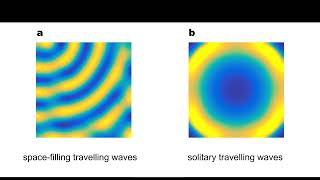
This supplemental video reviews the 2023 study on how reaction-diffusion models explain skin color patterns, showcasing wave dynamics, traveling waves, and the self-organizing processes underlying morphogenesis.
This video explores the reaction-diffusion model introduced by Alan Turing in 1952, highlighting its role in understanding vertebrate skin color patterning through mathematical frameworks, simulations, and stability…
RT @Silicon_alien: @bschne @lu_sichu @norvid_studies reaction, diffusion models are another classic concept https://t.co/2dnllEY9Pf this is…
Jun 22, 2025 · 1 share · 4,510 followersView post →
LC
Low fat sweaty cat
@Silicon_alien · X
@bschne @lu_sichu @norvid_studies reaction, diffusion models are another classic concept https://t.co/2dnllEY9Pf this is a good review
Jun 22, 2025 · 4 likes · 1 share · 263 followersView post →
BU
Biologie - UNIGE
@Biologie_UNIGE · X
RT @LANEVOL: Here's our new article in the Annual Review of Cell & Developmental Biology. We discuss why Turing’s Reaction-Diffusion models…
Oct 19, 2023 · 5 shares · 1,220 followersView post →
GE
Genetics & Evolution
@genevunige · X
RT @LANEVOL: Here's our new article in the Annual Review of Cell & Developmental Biology. We discuss why Turing’s Reaction-Diffusion models…
Oct 19, 2023 · 5 shares · 663 followersView post →
GF
Gareth Fraser
@garethjfraser · X
RT @LANEVOL: Here's our new article in the Annual Review of Cell & Developmental Biology. We discuss why Turing’s Reaction-Diffusion models…
Oct 18, 2023 · 5 shares · 3,310 followersView post →
MT
Milton Tan
@mtanichthys · X
RT @LANEVOL: Here's our new article in the Annual Review of Cell & Developmental Biology. We discuss why Turing’s Reaction-Diffusion models…
Oct 18, 2023 · 5 shares · 5,089 followersView post →
RC
Rory Cooper
@rorylcooper · X
RT @LANEVOL: Here's our new article in the Annual Review of Cell & Developmental Biology. We discuss why Turing’s Reaction-Diffusion models…
Oct 18, 2023 · 5 shares · 2,003 followersView post →
TL
The Milinkovitch-Tzika lab
@LANEVOL · X
Here's our new article in the Annual Review of Cell & Developmental Biology. We discuss why Turing’s Reaction-Diffusion models are effective for understanding skin colour patterning without parametrising the profusion of variables at lower spatial scales⬇️
https://t.co/0FOnJqm56w
Oct 18, 2023 · 13 likes · 5 shares · 945 followersView post →
 TL
TL



 AI
AI