The enthusiasm and focus on the therapeutic implications, such as references to mitigating radiation-induced cancers and the role of senolytic therapy, illustrate deep engagement and recognition of the research's potential importance, though some comments remain general summaries. The tone underscores a positive outlook on advances in aging and cancer prevention.
AgreementStrong agreement
Most discussions express strong support and enthusiasm for the research findings, emphasizing the significance of the potential impact on cancer prevention.
InterestHigh interest
The discussions demonstrate high interest, referencing specific details about the research and its implications, indicating engagement with the topic.
EngagementModerate engagement
Many posts mention specific aspects like the use of ABT-263 and its effects, showing a deep understanding and active interest, though some are more straightforward summaries which indicates moderate engagement.
ImpactHigh impact
The discussions highlight the potential of the research to influence future cancer treatments and aging studies, suggesting high perceived impact.
Abstract in brief
The study investigates how ionizing radiation (both low and high linear energy transfer) increases gastrointestinal cancer risk in mice, primarily through promoting cellular senescence and inflammatory signaling.
Researchers tested the senolytic drug ABT263, which eliminates senescent cells, and found that it reduced inflammation, catenin signaling, and tumor development after radiation exposure.
Overall, the findings suggest that targeting senescent cells with senolytic therapy like ABT263 could be an effective way to lower the chances of radiation-induced gastrointestinal cancers.]
Oct 21, 2025 · 4 likes · 4,404 followersView post →
AU
Aging-US
@AgingJrnl · X
#PaperoftheDay: "Senolytic agent ABT-263 mitigates low- and high-LET radiation-induced gastrointestinal cancer development in Apc1638N/+ mice"
DOI ⬇️
https://t.co/L32U9OEmcF
#aging #cancer #research #openaccess #peerreview #publishing
Feb 10, 2025 · 3 likes · 4,404 followersView post →
AU
Aging-US
@AgingJrnl · X
Longevity & Aging Series (S3, E4):
In this #episode, Dr. Shubhankar Suman @LombardiCancer discusses his #research, “Senolytic agent ABT-263 mitigates low- and high-LET radiation-induced gastrointestinal cancer development in Apc1638N/+ mice.”
https://t.co/ZcOYZm5PT4
#aging #oa
Jun 29, 2025 · 3 likes · 4,404 followersView post →
AU
Aging-US
@AgingJrnl · X
#PaperSpotlight:
A new #research paper was #published on January 8, 2025, titled "Senolytic agent ABT-263 mitigates low- and high-LET radiation-induced gastrointestinal cancer development in Apc1638N/+ mice." @gumedcenter
https://t.co/L32U9OEmcF
#aging #quote #cancer #oa https://t.co/PGdhPfIqcl
Feb 18, 2025 · 2 likes · 4,404 followersView post →
AU
Aging-US
@AgingJrnl · X
Longevity & Aging Series (S3, E4):
In this #episode, Dr. Shubhankar Suman @LombardiCancer discusses his #research, “Senolytic agent ABT-263 mitigates low- and high-LET radiation-induced gastrointestinal cancer development in Apc1638N/+ mice.”
https://t.co/ZcOYZm5PT4
#aging #oa
May 21, 2025 · 2 likes · 4,404 followersView post →
AU
Aging-US
@AgingJrnl · X
Longevity & Aging Series (S3, E4):
In this #episode, Dr. Shubhankar Suman @LombardiCancer discusses his #research, “Senolytic agent ABT-263 mitigates low- and high-LET radiation-induced gastrointestinal cancer development in Apc1638N/+ mice.”
https://t.co/ZcOYZm5PT4
#aging #oa
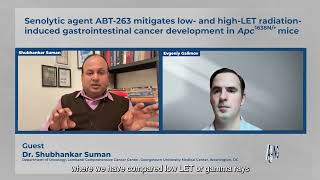
In this episode of the Longevity & Aging Series, Dr. Shubhankar Suman discusses how senolytic agent ABT-263 can mitigate gastrointestinal cancer development caused by ionizing radiation, highlighting potential…
AgingUS published this research paper on January 8 2025 in Volume 17 Issue 1 entitled Senolytic agent ABT-263 mitigates low and high-LET radiation induced gastrointestinal cancer in mice by researchers from Georgetown…
Longevity & Aging Series (S3, E4):
In this #episode, Dr. Shubhankar Suman @LombardiCancer discusses his #research, “Senolytic agent ABT-263 mitigates low- and high-LET radiation-induced gastrointestinal cancer development in Apc1638N/+ mice.”
https://t.co/ZcOYZm5PT4
#aging #oa
Aug 20, 2025 · 2 likes · 4,404 followersView post →
AU
Aging-US
@aging-us.bsky.social · Bluesky
Longevity & Aging Series (S3, E4):
In this #episode, Dr. Shubhankar Suman discusses his #research, “Senolytic agent ABT-263 mitigates low- and high-LET radiation-induced gastrointestinal cancer development in Apc1638N/+ mice.”
Longevity & Aging Series (S3, E4):
In this #episode, Dr. Shubhankar Suman @LombardiCancer discusses his #research, “Senolytic agent ABT-263 mitigates low- and high-LET radiation-induced gastrointestinal cancer development in Apc1638N/+ mice.”
https://t.co/ZcOYZm5PT4
#aging #oa
Longevity & Aging Series (S3, E4):
In this #episode, Dr. Shubhankar Suman discusses his #research, “Senolytic agent ABT-263 mitigates low- and high-LET radiation-induced gastrointestinal cancer development in Apc1638N/+ mice.”
www.youtube.com/watch?v=ClLO...
#aging #openaccess #publishing #series
Longevity & Aging Series (S3, E4):
In this #episode, Dr. Shubhankar Suman @LombardiCancer discusses his #research, “Senolytic agent ABT-263 mitigates low- and high-LET radiation-induced gastrointestinal cancer development in Apc1638N/+ mice.”
https://t.co/ZcOYZm5PT4
#aging #oa
Jun 29, 2025 · 3 likes · 4,404 followersView post →
AU
Aging-US
@AgingJrnl · X
Longevity & Aging Series (S3, E4):
In this #episode, Dr. Shubhankar Suman @LombardiCancer discusses his #research, “Senolytic agent ABT-263 mitigates low- and high-LET radiation-induced gastrointestinal cancer development in Apc1638N/+ mice.”
https://t.co/ZcOYZm5PT4
#aging #oa
May 29, 2025 · 2 likes · 4,404 followersView post →
AU
Aging-US
@aging-us.bsky.social · Bluesky
Longevity & Aging Series (S3, E4):
In this #episode, Dr. Shubhankar Suman discusses his #research, “Senolytic agent ABT-263 mitigates low- and high-LET radiation-induced gastrointestinal cancer development in Apc1638N/+ mice.”
Longevity & Aging Series (S3, E4):
In this #episode, Dr. Shubhankar Suman @LombardiCancer discusses his #research, “Senolytic agent ABT-263 mitigates low- and high-LET radiation-induced gastrointestinal cancer development in Apc1638N/+ mice.”
https://t.co/ZcOYZm5PT4
#aging #oa
May 21, 2025 · 2 likes · 4,404 followersView post →
AU
Aging-US
@aging-us.bsky.social · Bluesky
Longevity & Aging Series (S3, E4):
In this #episode, Dr. Shubhankar Suman from Georgetown University discusses his #research: “Senolytic agent ABT-263 mitigates low- and high-LET radiation-induced gastrointestinal cancer development in Apc1638N/+ mice.”
www.youtube.com/watch?v=ClLO...
#aging #oa
#PaperSpotlight:
A new #research paper was #published on January 8, 2025, titled "Senolytic agent ABT-263 mitigates low- and high-LET radiation-induced gastrointestinal cancer development in Apc1638N/+ mice." @gumedcenter
https://t.co/L32U9OEmcF
#aging #quote #cancer #oa https://t.co/PGdhPfIqcl
Feb 18, 2025 · 2 likes · 4,404 followersView post →
AU
Aging-US
@aging-us.bsky.social · Bluesky
#AgingResearch:
This #research paper was #published in Volume 17, Issue 1, titled "Senolytic agent ABT-263 mitigates low- and high-LET radiation-induced gastrointestinal cancer development in Apc1638N/+ mice."
#PressRelease ⬇️
aging-us.com/news-room/se...
#aging #cancer #oa #press #publishing
#PaperoftheDay: "Senolytic agent ABT-263 mitigates low- and high-LET radiation-induced gastrointestinal cancer development in Apc1638N/+ mice"
DOI ⬇️
https://t.co/L32U9OEmcF
#aging #cancer #research #openaccess #peerreview #publishing
Feb 10, 2025 · 3 likes · 4,404 followersView post →
AU
Aging-US
@aging-us.bsky.social · Bluesky
#AgingResearch:
"Senolytic agent ABT-263 mitigates low- and high-LET radiation-induced gastrointestinal cancer development in Apc1638N/+ mice" from Volume 17, Issue 1.
DOI ⬇️
doi.org/10.18632/agi...
#aging #oncology #research #openaccess #peerreview #publishing
Georgetown University Medical Center | Washington D.C. DC
Facebook
" Georgetown University Medical Center https://doi.org/10.18632/aging.206183 #aging #senolytics #carcinogenesis #inflammation #gastrointestinalcancer ...
 AU
AU