The discussions highlight the article's focus on intracrystalline diffusion and its effect on mixture separation, with posts referencing the importance of parameters like diffusional time constants and modeling methods such as Maxwell-Stefan. The tone conveys both respect for technical depth and optimism about practical impact, with words like 'crucial,' 'significance,' and 'innovation' indicating their appreciation of the study's contributions.
AgreementModerate agreement
Most discussions acknowledge the significance of the research, especially emphasizing its detailed insights into diffusion and modeling techniques.
InterestHigh interest
Posts indicate a high level of curiosity, with many expressing enthusiasm about the advanced modeling approaches and practical implications.
EngagementModerate engagement
Several comments delve into specific concepts like the Maxwell-Stefan formulation and the effects of diffusional influences, showing active engagement.
ImpactModerate impact
Participants recognize the potential of these findings to influence future research and industrial applications, reflecting perceived impact.
Abstract in brief
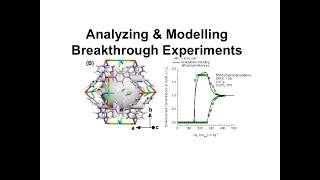
This article explains how intracrystalline diffusion affects the separation of mixtures in fixed bed adsorbers packed with microporous crystalline materials like MOFs and zeolites, focusing on how different diffusional influences can either work together or oppose each other to impact mixture adsorption.
Through experimental data, the study shows that the more mobile species can temporarily overshoot their expected loading levels inside single crystals, a phenomenon that can be accurately modeled using the Maxwell-Stefan diffusion formulation, which considers thermodynamic coupling effects—something the simpler Linear Driving Force model cannot capture.
The findings highlight that the key factors controlling breakthrough behavior are two parameters: a diffusional time constant and the gas-particle contact time, which together depend on the product of bed length, particle size, and gas velocity—this insight is crucial for designing and scaling up industrial adsorption systems.]
This video explains how intracrystalline diffusion influences mixture separation in microporous materials like MOFs and zeolites. It discusses how thermodynamic coupling affects adsorption, using Maxwell-Stefan…
This video explores the simulation of breakthrough experiments for the selective separation of propyne-propadiene mixtures, highlighting novel MOF materials for efficient separation and how modeling aligns with…
Many natural gas reserves contain nitrogen levels up to 20%, requiring reduction below 4% to meet pipeline standards. Pressure swing adsorption technology offers an economical solution for smaller capacity wells…
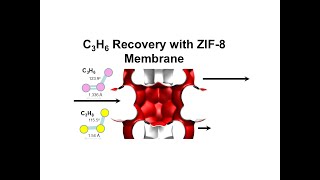
This video discusses the challenges in replacing traditional distillation with PSA technology for C3H6 and C3H8 separation, focusing on C3H6 purity and recovery, along with theoretical insights into intracrystalline…
This presentation analyzes transient breakthroughs for adsorption-desorption cycles for CO2-H2O mixtures in CALF20. The mixture adsorption equilibrium is described using the RASTNRTL model, highlighting the effects of…
The LDF model, used in PSA and based on assumptions of uncoupled diffusion and constant diffusivities, fails to accurately describe kinetic separations, especially when diffusion influences are coupled. Experimental…
The LDF model fails to accurately predict mixture separations in kinetic processes. This video discusses experimental findings on intracrystalline diffusion effects in fixed bed adsorbers using microporous materials…
This presentation explores how intracrystalline diffusivities influence separation performance in microporous materials like MOFs and zeolites, focusing on diffusion-driven effects that can enhance or reverse…
This video explores the challenge of separating propyne and propadiene in the petrochemical industry, highlighting a novel metalorganic framework with record productivity, and discusses how simulations align with…
This presentation focuses on mixture separations driven by differences in intracrystalline diffusivities in microporous materials. The Maxwell-Stefan formulation accounts for coupled fluxes of guest molecules, crucial…
This video discusses the use of Cogallate pellets for C2H4C2H6 separation, highlighting diffusional influences that are stronger at industrial scale despite using same-sized pellets. It emphasizes the importance of…
Many natural gas reserves contain nitrogen; to meet pipeline standards, nitrogen must be reduced below 4%. Pressure swing adsorption with LTA 4A zeolite offers an economical solution, leveraging diffusion selectivities…
This video discusses the importance of the Maxwell-Stefan formulation over LDF in modeling intracrystalline diffusion, supported by experimental data on mixture breakthroughs in zeolite-packed beds, highlighting…
This video focuses on the modeling of mixture desorption kinetics in pressure swing adsorption processes, using Maxwell-Stefan equations to analyze intracrystalline diffusion effects on separation efficiency in…
For production of alkene feedstocks of 99.95% purity required for polymerization reactors cryogenic distillation columns are employed for large scale separations of C2H4C2H6 and C3H6C3H8 mixtures. New MOF developments…
This video examines factors influencing breakthrough phenomena in fixed bed adsorbers, with insights into intracrystalline diffusion and its effects on mixture separation, using Maxwell-Stefan modeling to understand…
This video discusses the traditional cryogenic distillation methods for purifying alkene feedstocks, focusing on C2H4 and C2H6 separation. It highlights current challenges and the potential of metal-organic frameworks…
This video discusses the challenges of separating ethyne C2H2 from CO2 due to their similar properties and highlights a novel sulfate-pillared MOF, SOFOURTEPEZn, designed for efficient separation using dense…
This video revisits CO2H2O mixture adsorption in CALF20. It models transient uptake within a single crystallite at 303 K using unary isotherm data and discusses mixture adsorption equilibrium, highlighting the impact of…
This presentation discusses kinetically driven separations of C3H6/C3H8 mixtures using ZIF8, focusing on crystal size and contact times. It highlights the concept of optimal crystal sizes for effective separation based…
This presentation discusses the use of C3H6C3H8 separation using CHA zeolite through simulations analyzing contact times and diffusional influences on separation efficiency, emphasizing the impact of diffusional time…
The design of separation and catalytic technologies depends on understanding molecule diffusion within porous materials. This video explains how to determine the diffusional time constant using experimental data…
This video explores how kinetic separations exploit differences in intracrystalline diffusivities, leading to transient overshoots in binary mixture loadings. Using Maxwell-Stefan diffusion theory, it explains the…
This presentation discusses kinetically driven separation of C3H6 and C3H8 in ZIF-8, emphasizing the impact of crystal size and contact time on separations. Key insights include optimal crystal size and diffusion…
This video explores intracrystalline diffusion effects in MFI zeolites, demonstrating how mobile species can temporarily exceed expected loadings, modeled effectively using Maxwell-Stefan formulation, which accounts for…
This presentation discusses kinetically driven separations of C3H6/C3H8 mixtures using ZIF8, focusing on how crystal size and contact times influence separation efficiency, highlighting the concept of optimal crystal…
This presentation discusses kinetically driven separations of C3H6C3H8 mixtures using CHA zeolite, focusing on how crystal size and contact times influence diffusional effects essential for mixture separation efficiency.