Assessment of quitting versus using aspirin therapy in patients with stabilized coronary artery disease after stenting who require long-term oral anticoagulation: Rationale for and design of the AQUATIC double-blind randomized trial.
The overall tone suggests cautious optimism about the AQUATIC trial, with posts discussing its potential to shape treatment choices using words like 'important' and 'promising.' The references to the trial's design, such as 'double-blind' and 'randomized,' show an interest in the scientific rigor, while some posts emphasize the practical importance of balancing bleeding risks and heart attack prevention, highlighting its clinical impact.
AgreementModerate agreement
Most discussions acknowledge the importance of the study and its potential to influence treatment decisions, reflected in positive or neutral opinions.
InterestModerate interest
Participants show a moderate level of curiosity about the trial, as evidenced by their engagement with the research design and implications.
EngagementModerate engagement
Comments range from brief acknowledgments to more detailed reflections on the trial's methodology and significance, indicating moderate engagement.
ImpactNeutral impact
While the study is seen as relevant to clinical practice, opinions vary on its immediate impact; some see it as promising, others note the need for results.
Abstract in brief
The AQUATIC study is a clinical trial designed to determine whether patients with stable coronary artery disease who have stents and need long-term blood thinners should continue taking aspirin or stop it to reduce bleeding without increasing the risk of heart problems.
It involves 2000 high-risk patients who are randomly assigned to receive either blood thinners plus aspirin or blood thinners plus a placebo, with the goal of seeing which approach better prevents serious heart and blood vessel events while minimizing bleeding.
The main focus is to find the best balance between preventing severe cardiovascular issues like heart attacks and strokes, and avoiding dangerous bleeding, to guide long-term treatment decisions for these patients.
Assessment of quitting versus using aspirin therapy in patients with stabilized coronary artery disease after stenting who require long-term oral anticoagulation: Rationale for and design of the AQUATIC double-blind randomized trial
AQUATIC is an academic randomized double-blind https://t.co/bW1xtxJcUg
Aug 23, 2025 · 18 likes · 5 shares · 3,109 followersView post →
Prof. Bikdeli and Prof. Didier discuss the HIPRO study on extended treatment of provoked venous thromboembolism, presented at the 2025 European Society of Cardiology meeting. The study compares rivaroxaban monotherapy…
Prof Romain Didier and Prof Behnood Bikdeli discuss the AQUATIC study on antiplatelet drugs in patients with chronic coronary syndrome receiving oral anticoagulation, highlighting recent findings on therapy optimization…
RT @drbennisahmed: Assessment of quitting versus using aspirin therapy in patients with stabilized coronary artery disease after stenting w…
Aug 23, 2025 · 5 shares · 470 followersView post →
AM
Ahmed Bennis MD
@drbennisahmed · X
Assessment of quitting versus using aspirin therapy in patients with stabilized coronary artery disease after stenting who require long-term oral anticoagulation: Rationale for and design of the AQUATIC double-blind randomized trial
AQUATIC is an academic randomized double-blind https://t.co/bW1xtxJcUg
Aug 23, 2025 · 18 likes · 5 shares · 3,109 followersView post →
 AM
AM P
P HR
HR SB
SB AC
AC AS
AS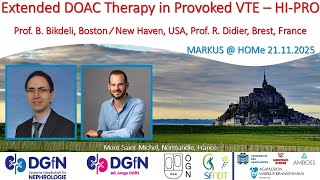

 S
S RL
RL D
D BF
BF EJ
EJ J
J SL
SL A
A HA
HA G
G LH
LH SM
SM