 DU
DU RP
RP E
E TE
TE PL
PL PB
PB NS
NS ÁP
ÁP DM
DM EA
EA JE
JE CB
CB TH
TH AF
AFRat challenges cat to fight near hole
Facebook
doi: 10.1098/rspb.2011.1169 https://www.ncbi.nlm.nih. gov/pmc/articles/PMC3248729/.
Nov 18, 2025
View →
Mentions
Extended reach
Total likes
Video views
AI synopsis
The discussions show a strong interest in the animal's unique chemical defenses, with many posts praising the discovery and sharing related facts, such as snakes using frog venom or animals stealing toxins; words like 'poisonous surprise' and 'cool animal' reflect enthusiasm and curiosity, while referencing specific research articles emphasizes a meaningful engagement with the scientific findings.
Most discussions highlight the novelty and importance of the research on the African crested rat's chemical defense, showing general support.
The posts demonstrate high curiosity, with many sharing detailed facts and expressing amazement about the animal's unique adaptations.
Discussions include references to specific research findings, additional animal behaviors, and related facts, indicating moderate engagement.
The conversations acknowledge the significance of the discovery in understanding animal defense mechanisms, though mostly in an informational way.
Thievery is a known survival strategy in the wild. But you couldn’t steal a toxin...or could you? Meet 5 animals that turn someone else’s poison into their own weapon of choice. https://t.co/fn1fPIkGoJ https://t.co/ixsypRD130
In an update to our series on bird evolution, we cover news in this field from the past year, including giant penguins, giant eagles, terror bird tracks, and birds with armored necks! Stick around to the end for an announcement on our human origins series. https://t.co/1hfUWyZO6w https://t.co/EZ8sDeqHDt
Late to the party on this one, but HOLY GUACAMOLE! Don't bite this RAT!! A poisonous surprise under the coat of the African crested rat
New episode of @TimeAndClades! @KilldeerCheer and I discuss the past year in fossil bird discoveries, including giant eagles, terror bird tracks, and birds with armored necks: https://t.co/uxxtMZetQS https://t.co/fd8WtSlyBn
@evolauterbur @joelmcglothlin @mariahlemurs @SESantanaM https://t.co/jjUfDxmtav
Tox on the day! 3 August 2011. Kingdon et al. publish paper which first describes a placental mammal, who chews the roots & bark of a highly toxic tree, and who then smears the toxin on its specially adapted fur to deter potential predators. #toxontheday https://t.co/WiKEdvZ5Az

This episode explores how some animals acquire and utilize poisons for survival. Meet species such as the African crested rat, which stores toxins from plants and displays them as a defense mechanism, showcasing complex…
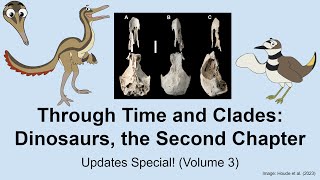
This update explores new discoveries in avian evolution since December 2022, including giant penguins, giant eagles, terror bird footprints, and armored-necked birds, highlighting recent advances in understanding bird…
RT @TimeAndClades: In an update to our series on bird evolution, we cover news in this field from the past year, including giant penguins,…
New episode of @TimeAndClades! @KilldeerCheer and I discuss the past year in fossil bird discoveries, including giant eagles, terror bird tracks, and birds with armored necks: https://t.co/uxxtMZetQS https://t.co/fd8WtSlyBn
RT @TimeAndClades: In an update to our series on bird evolution, we cover news in this field from the past year, including giant penguins,…
RT @TimeAndClades: In an update to our series on bird evolution, we cover news in this field from the past year, including giant penguins,…
RT @TimeAndClades: In an update to our series on bird evolution, we cover news in this field from the past year, including giant penguins,…
In an update to our series on bird evolution, we cover news in this field from the past year, including giant penguins, giant eagles, terror bird tracks, and birds with armored necks! Stick around to the end for an announcement on our human origins series. https://t.co/1hfUWyZO6w https://t.co/EZ8sDeqHDt
Tox on the day! 3 August 2011. Kingdon et al. publish paper which 1st describes a placental mammal, who chews the roots & bark of a highly toxic tree, and who then smears the toxin on its specially adapted fur to deter potential predators. #toxontheday https://t.co/WiKEdvZ5Az 1/3
Main research source for all this: Kingdon, Agwanda et al, 2012, A poisonous surprise under the coat of the African crested rat, Proc. R. Soc. B., 279, 675–680. Free to read here: https://t.co/2ETw1ZNbuL 10/10
@lypez3 Estes tem um estômago bem peculiar e único que pode processar esta toxina segundo o artigo que descreveu o comportamento https://t.co/gVUIgjvRzt
RT @eapcct: Tox on the day! 3 August 2011. Kingdon et al. publish paper which first describes a placental mammal, who chews the roots & bar…
Tox on the day! 3 August 2011. Kingdon et al. publish paper which first describes a placental mammal, who chews the roots & bark of a highly toxic tree, and who then smears the toxin on its specially adapted fur to deter potential predators. #toxontheday https://t.co/WiKEdvZ5Az
@ORodentia @EaronnScot This was only described scientifically about a decade ago https://t.co/43WGQXAs61
A thing that I learned today: There are snakes that will actually use the venom of venomous frogs they consume. https://t.co/he9dbuyadF
5 Toxins Animals Steal For Themselves https://t.co/S8HbF8NTcJ via @YouTube
https://t.co/k8biQSQntR
RT @SciShow: Thievery is a known survival strategy in the wild. But you couldn’t steal a toxin...or could you? Meet 5 animals that turn so…
5 Toxins Animals Steal For Themselves @ https://t.co/cth30ywFqm https://t.co/DFYK8zt6bO
RT @SciShow: Thievery is a known survival strategy in the wild. But you couldn’t steal a toxin...or could you? Meet 5 animals that turn so…
5 Toxins Animals Steal For Themselves https://t.co/sxVsrhZJ4d via @YouTube
RT @SciShow: Thievery is a known survival strategy in the wild. But you couldn’t steal a toxin...or could you? Meet 5 animals that turn so…
5 Toxins Animals Steal For Themselves https://t.co/CWpaqFAiCN via @YouTube
RT @SciShow: Thievery is a known survival strategy in the wild. But you couldn’t steal a toxin...or could you? Meet 5 animals that turn so…
New video by SciShow: 5 Toxins Animals Steal For Themselves https://t.co/SlUINvbXDv
RT @SciShow: Thievery is a known survival strategy in the wild. But you couldn’t steal a toxin...or could you? Meet 5 animals that turn so…
RT @SciShow: Thievery is a known survival strategy in the wild. But you couldn’t steal a toxin...or could you? Meet 5 animals that turn so…
Thievery is a known survival strategy in the wild. But you couldn’t steal a toxin...or could you? Meet 5 animals that turn someone else’s poison into their own weapon of choice. https://t.co/fn1fPIkGoJ https://t.co/ixsypRD130
Y aquí algunas referencias sobre el tema
Presumably, this is yet further adaptation to protect the maned rat against predators. Some references for today’s fact: -Picture and info on the strange skull of the maned rat (Kingdon et al., 2011: https://t.co/nt2uR4ITtX) -Maned rat photograph by S.B. Weinstein.
@IntegratEcology Must be the maned rat, and check out this cool paper: https://t.co/UwYJXRlv7S
Some references for today's fact: -Image 1 and the microscopic structure of the hairs of Lophiomys imhausi (Kingdon et al., 2011: https://t.co/nt2uR4ITtX) -Image 2 by Susannah Rouse.
A poisonous surprise under the coat of the African crested rat | Proceedings of the Royal Society B: Biological Sciences https://t.co/AWUzAbd9Mw
Tox on the day! 3 August 2011. Publication of paper which 1st described a placental mammal, who chews the roots & bark of a highly toxic tree, and who then smears the toxin on its specially adapted fur to deter potential predators. #toxontheday https://t.co/WiKEdvZ5Az
RT @kateumbers: Late to the party on this one, but HOLY GUACAMOLE! Don't bite this RAT!! A poisonous surprise under the coat of the Afric…
RT @kateumbers: Late to the party on this one, but HOLY GUACAMOLE! Don't bite this RAT!! A poisonous surprise under the coat of the Afric…
Late to the party on this one, but HOLY GUACAMOLE! Don't bite this RAT!! A poisonous surprise under the coat of the African crested rat
@WildliferSteph Such a cool animal! I was in possession of the n=1 crested rat from this study for about 45min. Still shocked that this didn't count as a coauthored contribution
A reference for today's fact: -Don't lick the maned rat (Kingdon et al., 2012: https://t.co/nt2uR4ITtX) As always, if you have any interesting rodent facts, research, or pictures you would like to share as a part of #YearoftheRatFacts do get in touch!
@evolauterbur @joelmcglothlin @mariahlemurs @SESantanaM https://t.co/jjUfDxmtav
doi: 10.1098/rspb.2011.1169 https://www.ncbi.nlm.nih. gov/pmc/articles/PMC3248729/.
doi: 10.1098/rspb.2011.1169 https://www.ncbi.nlm.nih. gov/pmc/articles/PMC3248729/.
doi: 10.1098/rspb.2011.1169 https://www.ncbi.nlm.nih. gov/pmc/articles/PMC3248729/.
doi: 10.1098/rspb.2011.1169 https://www.ncbi.nlm.nih. gov/pmc/articles/PMC3248729/.
doi: 10.1098/rspb.2011.1169 https://www.ncbi.nlm.nih. gov/pmc/articles/PMC3248729/.
doi: 10.1098/rspb.2011.1169 https://www.ncbi.nlm.nih. gov/pmc/articles/PMC3248729/.
doi: 10.1098/rspb.2011.1169 https://www.ncbi.nlm.nih. gov/pmc/articles/PMC3248729/.
... 10.1098/rspb.2011.1169 https://www.ncbi.nlm.nih.gov/pmc/articles/PMC3248729/. Log in · A poisonous surprise under the coat of the African ...
Proceedings of the Royal Society B. Vol. 279, February 22, 2012, p. 675. doi: 10.1098/rspb.2011.1169. Susan Milius ...
doi: 10.1098/rspb.2011.1169 https://www.ncbi.nlm.nih. gov/pmc/articles/PMC3248729/.
... -Audet, Fritz Vollrath Proc. R. Soc. B 2012 279 675-680; DOI: 10.1098/rspb.2011.1169. Publié le 11 janvier 2012 · Alantha. • il y a 10 a.
... , Fritz Vollrath Proc. R. Soc. B 2012 279 675-680; DOI: 10.1098/rspb.2011.1169. Veröffentlicht am 11. Januar 2012 · Alantha. • vor 10 Jahren.
... , Fritz Vollrath Proc. R. Soc. B 2012 279 675-680; DOI: 10.1098/rspb.2011.1169. Publicado em 11 de janeiro de 2012 · Alantha. • há 10 anos.
... , Maxime Boulet-Audet, Fritz Vollrath Proc. R. Soc. B 2012 279 675-680; DOI: 10.1098/rspb.2011.1169. Published 11 January 2012 · Alantha. • 10y ...
... 10.1098/rspb.2011.1169. Whittington, C., Koh, J., Warren, W., Papenfuss, A., Torres, A., Kuchel, P., & Belov, K. (2009). Understanding and ...
... 10.1098/rspb.2011.1169. Whittington, C., Koh, J., Warren, W., Papenfuss, A., Torres, A., Kuchel, P., & Belov, K. (2009). Understanding and ...
... 10.1098/rspb.2011.1169. Vetenskapsradion niklas.zachrisson@sverigesradio.se. Läs mer. Relaterade länkar. Forskarnas Abstract om manråttans ...
... 10.1098/rspb.2011.1169 wissenschaft.de ? Marion Martin. © wissenschaft.de. Teilen: Facebook · Twitter · LinkedIn · Xing; Newsletter; Drucken.
B 10.1098/rspb.2011.1169, 2011. Mähnenratte beim Giftmischen. Eine Mähnenratte (Lophiomys imhausi) beim Giftmischen: Das Tier zerkaut ...
... 10.1098/rspb.2011.1169). (Proceedings of the Royal Society B / University of Oxford / dapd, 03.08.2011 – NPO). 3. August 2011. Keine Meldungen ...
They have also – clearly – evolved immunity to the toxins. Journal reference: Proceedings of the Royal Society B, DOI: 10.1098/rspb.2011.1169.
... 10.1098/rspb.2011.1169. Images from Jonathan Kingdon and Kevin Deacon. More on poisonous defences: Moth and plant hit on the same ways of ...