The discussions reflect a strong interest in the aggressive parasitic tactics of honeyguides, as seen in phrases like 'natural-born killers' and references to their deadly feeding behaviors, which demonstrate curiosity and recognition of their significance, while tone ranges from awe to scientific intrigue.
AgreementModerate agreement
Most discussions acknowledge and support the fascinating and somewhat controversial findings about honeyguide behavior, though some mention its parallels with other brood parasites like cuckoos.
InterestHigh interest
Posts show high curiosity about the unique hunting and parasitic strategies of honeyguides, highlighting their killing behavior and evolutionary adaptations.
EngagementModerate engagement
Participants actively comment on the details of the study and related bird behaviors, sharing observations and asking questions, indicating moderate but meaningful engagement.
ImpactModerate impact
The features of the study are recognized as significant in understanding bird species and their complex behaviors, with some emphasizing the importance of such research for ornithology and evolutionary biology.
Abstract in brief
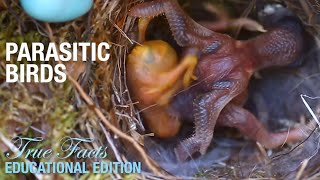
The study reports the first detailed observations of greater honeyguides killing host chicks using their specially adapted bill hooks, a behavior rarely documented in nature.
Adult honeyguides puncture host eggs when laying their own, leading to kills within hours after the hatchling emerges, often resulting in the death of all host young.
Despite being blind and living in darkness, honeyguides attack host chicks with sustained biting, grasping, and shaking, often within 15 minutes, demonstrating a highly effective brood parasitic strategy.]
Honeyguides are natural-born killers - like cuckoos, they are brood parasites, and the first thing going through the mind of a honeyguide chick when it hatches from its egg is:
MURDER
royalsocietypublishing.org/doi/10.1098/...
Today's #BirdsAtTea is the Greater Honeyguide. Like cuckoos, these #birds are brood parasites, laying eggs in barbet & bee-eater nests (and slaughtering the young with a hooked beak: https://t.co/Ol9gCnGQpO), but today's story is about their guiding behaviour. 1/5 #ornithology https://t.co/Krcvx33ThE
May 6, 2020 · 5 likes · 1 share · 1,511 followersView post →
SH
Selle Higgins
@safariwithselle · X
RT @TZBirder: Today's #BirdsAtTea is the Greater Honeyguide. Like cuckoos, these #birds are brood parasites, laying eggs in barbet & bee-ea…
May 6, 2020 · 1 share · 1,682 followersView post →
Brood parasites like Vidua finches use mimicry to deceive host birds into raising their offspring. This study highlights how these finches mimic both visual and auditory traits of their grassfinch hosts, showcasing the…
This educational video explores how brood parasites like Vidua finches use mimicry to deceive host birds into raising their young. Discover how these finches mimic both the visual and auditory traits of specific…
This study investigates how slime moulds, despite being unicellular, can learn and remember, specifically focusing on their ability to habituate to a sodium repellent, store this information during a dormant state, and…
Honeyguides are natural-born killers - like cuckoos, they are brood parasites, and the first thing going through the mind of a honeyguide chick when it hatches from its egg is:
MURDER
royalsocietypublishing.org/doi/10.1098/...
RT @TZBirder: Today's #BirdsAtTea is the Greater Honeyguide. Like cuckoos, these #birds are brood parasites, laying eggs in barbet & bee-ea…
May 6, 2020 · 1 share · 1,682 followersView post →
CB
Colin Beale
@TZBirder · X
Today's #BirdsAtTea is the Greater Honeyguide. Like cuckoos, these #birds are brood parasites, laying eggs in barbet & bee-eater nests (and slaughtering the young with a hooked beak: https://t.co/Ol9gCnGQpO), but today's story is about their guiding behaviour. 1/5 #ornithology https://t.co/Krcvx33ThE
May 6, 2020 · 5 likes · 1 share · 1,511 followersView post →
 CB
 SH