The posts collectively express enthusiasm about the symbiosis, with mentions of coral diversity and the beauty of the relationship, using positive words like 'sweet' and 'beautiful.' The tone is light and appreciative, indicating general interest but minimal deep engagement or critical impact, reflecting a focus on the visual and fascinating aspects of coral algae relationships.
AgreementModerate agreement
Most discussions highlight agreement with the article's depiction of coral symbiosis as beneficial and essential, especially emphasizing the mutualistic relationship of algae providing nutrients.
InterestHigh interest
Posts demonstrate high interest through expressions like 'many species share a sweet trait' and noting the beauty of the symbiosis, indicating engagement with the subject matter.
EngagementModerate engagement
While brief, comments like 'Woah this is beautiful!' and tagging others show some engagement, although they lack in-depth analysis or critique.
ImpactModerate impact
The posts suggest the topic raises awareness about coral biology, but the comments are largely superficial, implying limited immediate impact beyond general interest.
Abstract in brief
The article discusses the symbiosis between cnidarians (like corals and sea anemones) and intracellular dinoflagellate algae (Symbiodinium), highlighting its vital role in coral reef survival, especially in nutrient-poor tropical waters.
It emphasizes that our understanding of this symbiosis, particularly at the cellular level and its connection to coral calcification, is limited and urges a renewed focus on fundamental cellular processes such as recognition, biomass regulation, metabolic exchange, and calcification.
Examples from other cnidarian-alga relationships, like the green Hydra with its chlorophyte symbiont, are used to shed light on these processes and guide future research directions for better understanding and preserving coral reef ecosystems.]
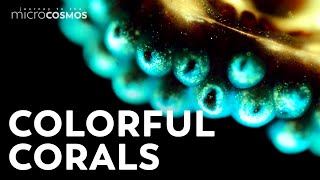
Many species of coral, both the soft and stony, share a sweet trait: a symbiotic relationship with algae called zooxanthellae! The algae provides corals with nutrients that make them colorful in exchange for housing and protection.
https://t.co/4fwExVTLrN https://t.co/tFiXEUYVp5
May 9, 2022 · 14 likes · 2 shares · 7,933 followersView post →
PB
Paul Burt
@ThatMightBePaul · X
Woah this is beautiful! cc @dianethompso https://t.co/qbpIBabXiM
Explore the cellular biology of corals and their symbiotic dinoflagellate algae, highlighting their essential role in coral reef ecosystems. Focus is on recognition, metabolic exchange, and calcification processes…
This video explains Zooxanthellae, unicellular microalgae essential for coral health. These dinoflagellates perform photosynthesis, providing nutrients to corals, which is vital for reef building and ecosystem…
RT @JourneyToMicro: Many species of coral, both the soft and stony, share a sweet trait: a symbiotic relationship with algae called zooxant…
May 12, 2022 · 2 shares · 1,420 followersView post →
P
Peacheserratica
@Peacheserratica · X
RT @JourneyToMicro: Many species of coral, both the soft and stony, share a sweet trait: a symbiotic relationship with algae called zooxant…
May 10, 2022 · 2 shares · 285 followersView post →
JM
Journey to the Microcosmos
@JourneyToMicro · X
Many species of coral, both the soft and stony, share a sweet trait: a symbiotic relationship with algae called zooxanthellae! The algae provides corals with nutrients that make them colorful in exchange for housing and protection.
https://t.co/4fwExVTLrN https://t.co/tFiXEUYVp5
May 9, 2022 · 14 likes · 2 shares · 7,933 followersView post →
PB
Paul Burt
@ThatMightBePaul · X
Woah this is beautiful! cc @dianethompso https://t.co/qbpIBabXiM
(Evolutionary Cell Biology) Bosch, Thomas C. G. - Hadfield, Michael ...
News
doi: 10.1128/MMBR.05014-11. Deines, P., T. Lachnit, and T. C. G. Bosch. 2017. “Competing Forces Maintain the Hydra Metaorganism.” Immunological Reviews 279 ...
The Sentient Cell The Cellular Foundations of Consciousness | PDF ...
News
https://doi.org/10.1128/MMBR.05014-11. Dawkins, R. (1976/1989). The Selfish Gene. New York: Oxford University Press. Deacon, T. W. (2011). Incomplete Nature ...
(doi:10.1128/MMBR.05014-11) for statistical computing. Vienna, Austria: R the ultrastructure of symbiotic Zooxanthellae 40. McBride BB, Muller-Parker G ...
Kingdom Chromista and Its Eight Phyla - Cavalier-Smith 2017 | PDF ...
News
Microbiol Mol Biol Rev 76:229–261. Natl Acad Sci U S A 91:11368–11372 https://doi.org/10.1128/MMBR.05014-11. Cavalier-Smith T, Lewis R, Chao EE, Oates B ...