 BL
BL DS
DS AS
AS RD
RD DF
DF AK
AK TJ
TJ 苗S
苗S10 1098@rsos 150340 | PDF | Tooth
News
(doi:10.1126/science.1229237) 67. Gingerich PD. 1976 Cranial anatomy and evolution Primates) from Greece. J. Vert. Paleontol. 28, 52. Omland KE. 1999 The ...
Dec 12, 2025
View →
Mentions
Extended reach
Total likes
Video views
AI synopsis
Overall, posts express strong agreement and high interest, often highlighting the study's challenge to previous molecular hypotheses, such as references to fossils versus molecular clocks. The tone varies from academic engagement to enthusiasm, for example, one post calls the research a 'valuable contribution' while others discuss the implications for understanding the origin of placental mammals.
Most posts support the findings and acknowledge the significance of the research, with some emphasizing mounting evidence and scientific debate.
Discussions focus intensely on the implications of the study, showing high curiosity and engagement with the topic of mammal evolution.
Many users reference specific methods, evidence, or broader debates, indicating active participation, though some posts are more surface-level or react with shared enthusiasm.
Discussants seem to recognize this research as a meaningful advancement in understanding mammalian evolution, with potential to influence future studies and debates.
@Mad_Lancaster @denisjabaudon @WiringTheBrain There is mounting evidence supporting this notion https://t.co/C85vWcmYfF https://t.co/6SiYJLJ97X
Human #CTScan from the Visible Human Project: https://t.co/Q4RTOC8qg6. Our cat #CTScans available for free download at: https://t.co/YNoVzAgi7m. Estimate of 60+ million years since the most recent common ancestor of humans & cats from O'Leary et al. 2013: https://t.co/4TkdPMRccF.
@pastramimachine @TJNear This seems to be an artefact of the molecular clocks. The hypothesis of pre K-Pg radiation of modern placental mammals was falsified many times on the grounds of incongruence with the preservational constraints of the fossil record https://t.co/q8vC9kaxUz https://t.co/X5S1GMMgiJ
@Jesus_is_G_d @bubbacav85 @TertiusIII @TakeThatEpi @carlsmythe @tighe15 @StandBackUp2 @commonsensejan @michellmybell1 @rmbctious @ReviewResist @donholtmac @Cern_lXXl @Loriniowa @TedPerkins10 @LeannEAF @umfpt @Schmoop0521 @andyguy @MaryVMos1 @tklforgiven @geraldpayne25 @surgerysleeper @rorylane @rafearia @the_godparticle @RLBays @zythophiliac @feyeleanor @alan244g @phyzayo @funkydoolah @ScientiaPercept @2Cents69 @Mwforhr @omeagoz @Denbar64 @CollinOctantis @Kopernikus1966 @bobcat7000 @paulr140 @Pamiekp @TiSeven2 @CATGOD20 @delology @SteveTiger999 @amateurexegete Springer, Mark S., Robert W. Meredith, Emma C. Teeling, & William J. Murphy. 2013. “Technical Comment on ‘The Placental Mammal Ancestor and the Post-K-Pg Radiation of Placentals’.” Science 341 (9 August): 613.
@Jesus_is_G_d @bubbacav85 @TertiusIII @TakeThatEpi @carlsmythe @tighe15 @StandBackUp2 @commonsensejan @michellmybell1 @rmbctious @ReviewResist @donholtmac @Cern_lXXl @Loriniowa @TedPerkins10 @LeannEAF @umfpt @Schmoop0521 @andyguy @MaryVMos1 @tklforgiven @geraldpayne25 @surgerysleeper @rorylane @rafearia @the_godparticle @RLBays @zythophiliac @feyeleanor @alan244g @phyzayo @funkydoolah @ScientiaPercept @2Cents69 @Mwforhr @omeagoz @Denbar64 @CollinOctantis @Kopernikus1966 @bobcat7000 @paulr140 @Pamiekp @TiSeven2 @CATGOD20 @delology @SteveTiger999 @amateurexegete O’Leary, Maureen et al. 2013. “The Placental Mammal Ancestor and the Post-K-Pg Radiation of Placentals.” Science 339 (8 February): 662-667.
The Placental Mammal Ancestor and the Post–K-Pg Radiation of Placentals | Science https://t.co/nyuyjxREzR

Comparative genomic studies of primates help us understand the evolution of the human genome. Recent research featuring genomic data from 186 primate species clarifies evolutionary relationships and has implications for…
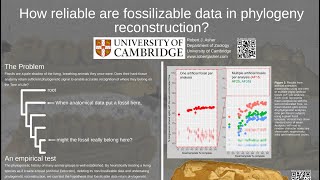
This video discusses the reliability of fossilizable data in constructing phylogenies, highlighting recent research that challenges previous molecular findings and emphasizes phenomic evidence for mammal evolution…
https://t.co/xN4ytDpe3L Love a good palaeo paper in the morning. I know the topic of ancestors for large groups is debated but I really liked the takes in this study. If anyone has good reads on a more recent state of the placental mammal origin debate, I'd love to read them.
The Placental Mammal Ancestor and the Post–K-Pg Radiation of Placentals | Science https://t.co/nyuyjxREzR
@pastramimachine @TJNear This seems to be an artefact of the molecular clocks. The hypothesis of pre K-Pg radiation of modern placental mammals was falsified many times on the grounds of incongruence with the preservational constraints of the fossil record https://t.co/q8vC9kaxUz https://t.co/X5S1GMMgiJ
@robertsharp59 The paper https://t.co/47EfAbuHa7 The ancestor https://t.co/gHo5G09dej
@Mad_Lancaster @denisjabaudon @WiringTheBrain There is mounting evidence supporting this notion https://t.co/C85vWcmYfF https://t.co/6SiYJLJ97X
Human #CTScan from the Visible Human Project: https://t.co/Q4RTOC8qg6. Our cat #CTScans available for free download at: https://t.co/YNoVzAgi7m. Estimate of 60+ million years since the most recent common ancestor of humans & cats from O'Leary et al. 2013: https://t.co/4TkdPMRccF.
https://t.co/WqKltyFesp // 早期胎盘动物每个象限有四个前磨牙 非胎盘真兽可能有五个... https://t.co/DocFl3Xlzt
@Jesus_is_G_d @bubbacav85 @TertiusIII @TakeThatEpi @carlsmythe @tighe15 @StandBackUp2 @commonsensejan @michellmybell1 @rmbctious @ReviewResist @donholtmac @Cern_lXXl @Loriniowa @TedPerkins10 @LeannEAF @umfpt @Schmoop0521 @andyguy @MaryVMos1 @tklforgiven @geraldpayne25 @surgerysleeper @rorylane @rafearia @the_godparticle @RLBays @zythophiliac @feyeleanor @alan244g @phyzayo @funkydoolah @ScientiaPercept @2Cents69 @Mwforhr @omeagoz @Denbar64 @CollinOctantis @Kopernikus1966 @bobcat7000 @paulr140 @Pamiekp @TiSeven2 @CATGOD20 @delology @SteveTiger999 @amateurexegete Springer, Mark S., Robert W. Meredith, Emma C. Teeling, & William J. Murphy. 2013. “Technical Comment on ‘The Placental Mammal Ancestor and the Post-K-Pg Radiation of Placentals’.” Science 341 (9 August): 613.
@Jesus_is_G_d @bubbacav85 @TertiusIII @TakeThatEpi @carlsmythe @tighe15 @StandBackUp2 @commonsensejan @michellmybell1 @rmbctious @ReviewResist @donholtmac @Cern_lXXl @Loriniowa @TedPerkins10 @LeannEAF @umfpt @Schmoop0521 @andyguy @MaryVMos1 @tklforgiven @geraldpayne25 @surgerysleeper @rorylane @rafearia @the_godparticle @RLBays @zythophiliac @feyeleanor @alan244g @phyzayo @funkydoolah @ScientiaPercept @2Cents69 @Mwforhr @omeagoz @Denbar64 @CollinOctantis @Kopernikus1966 @bobcat7000 @paulr140 @Pamiekp @TiSeven2 @CATGOD20 @delology @SteveTiger999 @amateurexegete O’Leary, Maureen et al. 2013. “The Placental Mammal Ancestor and the Post-K-Pg Radiation of Placentals.” Science 339 (8 February): 662-667.
(doi:10.1126/science.1229237) 67. Gingerich PD. 1976 Cranial anatomy and evolution Primates) from Greece. J. Vert. Paleontol. 28, 52. Omland KE. 1999 The ...
Science 339, 662–667. (2013). doi: 10.1126/science.1229237; pmid: 23393258. 35. J. A. Esselstyn, C. H. Oliveros, M. T. Swanson, B. C. Faircloth,. Investigating ...
placentals. „Science”. 339 (6120), s. 662–667, 2013. DOI: 10.1126/science.1229237 (https:// doi.org/10.1126/science.1229237). (ang.). 3. J. David Archibald ...
doi:10.1126/science.1229237 (https://doi.org/10.1126%2Fscience.1229237). hdl:11336/7302 (https://hdl.handle.net/11336%2F7302). PMID 23393258 (https://pubmed ...
The Placental Mammal Ancestor and the Post–K-Pg Radiation of Placentals. Science. 339 (6120): 662-667. DOI: 10.1126/science.1229237 · pskhun ที่ 9:49 AM.
Science. 8 Feb 2013. Vol 339, Issue 6120. pp. 662-667. DOI: 10.1126/science.1229237 · PREVIOUS ARTICLE. Rif1 Prevents Resection of DNA Breaks and Promotes ...
AnywhereScienceScience AdvancesScience ImmunologyScience RoboticsScience SignalingScience Translational Medicine ... /doi/10.1126/science.1229237 · Abstract.
Science 339: 662–667. DOI: 10.1126/science.1229237. PESSAGNO, E.A. 1969. Upper Cretaceous stratigraphy of the western Gulf Coast area of Mexico, Texas, and ...
662O) . doi:10.1126/science.1229237 (https://doi.org/10.1126%2. Fscience.1229237) . hdl:11336/7302 (https://hdl.handle.n et/11336%2F7302) ...
Science 339, mammals. Genome Res. 13, 1880–1888 (2003). doi: 10.1101/ 662–667 (2013). doi: 10.1126/science.1229237; across the X and ...
Science 339,. 662–667 (2013). doi: 10.1126/science.1229237; pmid: 23393258. 41. D. Vanderpool et al., Primate phylogenomics uncovers multiple.
662O (https://ui.adsabs.harvard.edu/abs/2013Sci...339..662O). doi:10.1126/science.1229237 (https://doi.org/10.1126%2Fscience.1229237). hdl ...
2013 Science 339, 662–667. (DOI: 10.1126/science.1229237)) performed a fossil-only dating analysis of mammals, concluding that the ancestor ...
Velazco, Marcelo Weksler, John R. Wible and Andrea L. Cirranello, 8 February 2013, Science. DOI: 10.1126/science.1229237. Never miss a ...
Science, 2013. DOI: 10.1126/science.1229237 (About DOIs). Listing image: Carl Buell. Photo of John Timmer. John Timmer Senior Science Editor.
... 10.1126/science.1229237). (Science, 08.02.2013 – NPO). 8. Februar 2013. Keine Meldungen mehr verpassen – mit unserem wöchentlichen ...
... Science, doi: 10.1126/science.1229237 © wissenschaft.de – Martin Vieweg. © wissenschaft.de. Teilen: Facebook · Twitter · LinkedIn · Xing ...
Science. Vol. 339, February 8, 2013, p. 662. doi: 10.1126/science.1229237. [Go to] · Erin Wayman. About Erin Wayman · E-mail · X. Erin Wayman is ...
The Placental Mammal Ancestor and the Post-K-Pg Radiation of Placentals. Science, 2013; 339 (6120): 662 DOI: 10.1126/science.1229237. Cite This ...
The Placental Mammal Ancestor and the Post-K-Pg Radiation of Placentals. Science, 2013; 339 (6120): 662 DOI: 10.1126/science.1229237. Cite This ...
Science news and long reads from expert journalists, covering developments in science ... Journal reference: Science, DOI: 10.1126/science.1229237.
Der Artikel stellt nur unzureichend das eigentlich relevante aus dem Artikel der Science dar (DOI:10.1126/science.1229237),ganz einfach aus ...