The discussions reflect a balanced interest in the technical improvements, such as the 36.2% increase in depth accuracy, with some posts highlighting the practical applications in noise reduction and 3D imaging, while others mention related topics like automatic captioning, suggesting a broader curiosity about technological integration and future implications.
AgreementModerate agreement
Most discussions recognize the advancements presented in the publication, especially regarding the improvements in depth accuracy and imaging techniques.
InterestModerate interest
Posts demonstrate moderate interest, with some enthusiasm about the technical details and potential applications, but little expressed excitement beyond professional curiosity.
EngagementModerate engagement
Participants engage with specific aspects like noise reduction methods and imaging accuracy, indicating a moderate level of in-depth involvement.
ImpactModerate impact
The discussions hint at potential significance, particularly in fields like microscopy and remote sensing, though explicit claims about transformative impact are limited.
Abstract in brief
Imagers that use their own light can capture 3D structure and reflectivity data, especially at low light conditions.
Photon-counting detectors need many detected photons to reduce noise in these low-light images.
The new "first-photon imaging" technique captures 3D structure and reflectivity from the first detected photon per pixel, making it useful for microscopy and remote sensing, even in noisy environments.
Thanks to @uclastat @uclaphyssci for hosting me on Friday! Had a great time and looking forward to an in-person visit. The talk titled Poisson and Marked Poisson Processes in 3D Imaging and Microscopy is available online at https://t.co/tFoy01NPzx
Jan 24, 2021 · 9 likes · 1 share · 774 followersView post →
AP
APL Photonics
@aplphotonics · X
Just published in @aplphotonics - “First-photon imaging with independent depth reconstruction”: APL Photonics: Vol 7, No 3 https://t.co/3r44DbW145
Mar 20, 2022 · 1 like · 3,165 followersView post →
VG
Vivek Goyal
@ProfessorGoyal · X
@ergodicwalk @roydyates Zoom does a reasonable job, too. I would love to know if one automatic captioning system is consistently best.
I cleaned up a .vtt file produced by Zoom and uploaded it along with a video to YouTube in this one case: https://t.co/WoupikpZu3
An improved first-photon imaging scheme, in which reflectivity and depth are reconstructed independently, is proposed to address severe noises. Results showed a 36.2% improvement in depth accuracy. https://t.co/x0KQqU8bQx
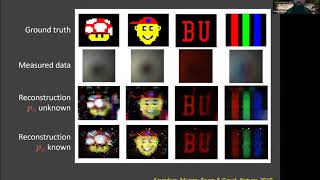
This video explores how computational methods enable image recovery from weak signals, focusing on first-photon imaging and its applications in lidar and non-line-of-sight imaging, highlighting its effectiveness in…
This seminar discusses how Poisson process models enhance 3D imaging, especially in low-light and high-noise conditions, leading to accurate depth and reflectivity measurements with minimal photon detections.
An improved first-photon imaging scheme, in which reflectivity and depth are reconstructed independently, is proposed to address severe noises. Results showed a 36.2% improvement in depth accuracy. https://t.co/x0KQqU8bQx
Just published in @aplphotonics - “First-photon imaging with independent depth reconstruction”: APL Photonics: Vol 7, No 3 https://t.co/3r44DbW145
Mar 20, 2022 · 1 like · 3,165 followersView post →
VG
Vivek Goyal
@ProfessorGoyal · X
Thanks to @uclastat @uclaphyssci for hosting me on Friday! Had a great time and looking forward to an in-person visit. The talk titled Poisson and Marked Poisson Processes in 3D Imaging and Microscopy is available online at https://t.co/tFoy01NPzx
Jan 24, 2021 · 9 likes · 1 share · 774 followersView post →
VG
Vivek Goyal
@ProfessorGoyal · X
@ergodicwalk @roydyates Zoom does a reasonable job, too. I would love to know if one automatic captioning system is consistently best.
I cleaned up a .vtt file produced by Zoom and uploaded it along with a video to YouTube in this one case: https://t.co/WoupikpZu3
 AP
AP AP
AP