
Synopsis of Social media discussions
The collective discussions reflect a strong appreciation for DESeq2, exemplified by phrases like 'classic' and 'highly cited,' alongside mentions of educational activities such as workshops and code sharing, which indicate both high interest and engagement. The tone of admiration and curiosity highlights the publication's perceived importance and the community’s active involvement in learning and applying the method.
Agreement
Moderate agreementMost discussions recognize the significance and utility of the DESeq2 paper, with some describing it as a classic or highly cited work, indicating general agreement on its value.
Interest
High level of interestPosts show high interest by highlighting the paper's accessibility, referencing workshops, and sharing resources like code on Github, demonstrating enthusiasm and engagement with the content.
Engagement
High engagementComments include questions about manuscript choices, summaries of the paper's importance, and mentions of workshops, reflecting deep involvement and discussion beyond surface level.
Impact
Moderate level of impactThe widespread citations, mention of its citation status on bioRxiv, and emphasis on its clarity suggest the publication has a notable influence on RNA-seq analysis and bioinformatics communities.
Social Mentions
YouTube
7 Videos
3 Posts
10 Posts
Blogs
14 Articles
News
12 Articles
2 Posts
Metrics
Video Views
250,358
Total Likes
3,490
Extended Reach
317,055
Social Features
48
Timeline: Posts about article
Top Social Media Posts

R-Ladies Tunis
Happy to share with you the materials for our last #R4Bioinfo meetup while we have been hosting @mard113 and @steman_research who took us through an incredible #workshop.
➡️Code on Github: https://t.co/KGwnx9Jxef
view full post
Steven Ge
@mikelove @s_anders_m @wolfgangkhuber That's why the 2014 DESeq2 paper is such a classic, easily understood by non-statisticians like me. https://t.co/pQzs7lW7ei
view full post
Scite
"Moderated estimation of fold change and dispersion for RNA-seq data with DESeq2" is the most highly cited preprint on @biorxivpreprint. https://t.co/SSUBMSUrjO
view full post
Michael Love
@NM_Reid Check out the DESeq2 paper
https://t.co/sAYQTvVTHX https://t.co/aLn45bqUEr
view full post
Rstats
RT @RLadiesTunis: Happy to share with you the materials for our last #R4Bioinfo meetup while we have been hosting @mard113 and @steman_rese…
view full post
Posts referencing the article

Understanding DESeq2 for Differential Gene Expression Analysis in RNAseq
This video introduces DESeq2, a key tool for analyzing count data from RNA sequencing to identify differentially expressed genes, explaining its underlying model and steps for accurate results.

January 22, 2022
160,637 views
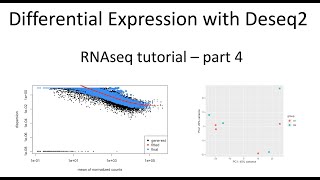
Analyzing Differential Gene Expression with DESeq2 in RNAseq Data
This tutorial demonstrates how to perform differential gene expression analysis using DESeq2. It covers input data preparation, PCA, dispersion QC, and output interpretation, facilitating further investigation in R, Python, or Excel.
December 12, 2021
62,082 views

Understanding the Use of Negative Binomial in RNA-Seq Data Analysis
DESeq2 analyzes RNA-seq data by estimating gene expression changes, accounting for variability and outliers, leading to more accurate results. The video explains the statistical models and distributions, including how Poisson-based approaches are used.
April 29, 2022
25,553 views

Advanced Statistical Methods for RNA-Seq Data Analysis in Computational Biology
This lecture covers statistical techniques including Negative Binomial, ComBat, DESeq2, and GLM for RNA-seq analysis, focusing on accurate differential gene expression estimation. DESeq2 uses shrinkage estimation to improve results' stability and interpretability.
January 27, 2022
639 views

Normalization Techniques for Single-Cell RNA Sequencing Data
This lecture discusses the significant cell-to-cell variation in scRNA-seq data and introduces a modeling framework using regularized negative binomial regression. It aims to normalize and stabilize variance to enhance downstream analyses while reducing technical biases.
April 10, 2024
564 views


Analyzing Differential Gene Expression with DESeq2 in RNA-Seq Data
In this episode, Michael Love discusses differential gene expression analysis from bulk RNASeq data, focusing on DESeq2 and related packages. The video covers the tools' history, theory, and practical applications in bioinformatics.
November 16, 2023
359 views
-
Mike Love et al's DESeq2 paper from the same year is also a great article for those being introduced to RNA-seq data https://t.co/ByvdkobF9i
view full postFebruary 24, 2024
-
Yueqiang Zhang
@JohnZha02385409 (Twitter)"Moderated estimation of fold change and dispersion for RNA-seq data with DESeq2 | Genome Biology | Full Text" https://t.co/Z5Or7rWFUt
view full postOctober 23, 2021
-
Steven Ge
@StevenXGe (Twitter)@mikelove @s_anders_m @wolfgangkhuber That's why the 2014 DESeq2 paper is such a classic, easily understood by non-statisticians like me. https://t.co/pQzs7lW7ei
view full postSeptember 13, 2021
5
-
R Tweets
@rstats_tweets (Twitter)RT @RLadiesTunis: Happy to share with you the materials for our last #R4Bioinfo meetup while we have been hosting @mard113 and @steman_rese…
view full postApril 24, 2021
3
-
Rstats
@rstatstweet (Twitter)RT @RLadiesTunis: Happy to share with you the materials for our last #R4Bioinfo meetup while we have been hosting @mard113 and @steman_rese…
view full postApril 24, 2021
3
-
Mouna Belaid ➖ @mouna_belaid@mastodon.social
@mounaa_belaid (Twitter)RT @RLadiesTunis: Happy to share with you the materials for our last #R4Bioinfo meetup while we have been hosting @mard113 and @steman_rese…
view full postApril 24, 2021
3
-
R-Ladies Tunis
@RLadiesTunis (Twitter)Happy to share with you the materials for our last #R4Bioinfo meetup while we have been hosting @mard113 and @steman_research who took us through an incredible #workshop. ➡️Code on Github: https://t.co/KGwnx9Jxef
view full postApril 24, 2021
9
3
-
Nadav Yayon
@YayonNadav (Twitter)@slobentanzer @MicrobiomDigest Which manuscript would you choose to claim for yourself? Perhaps this? https://t.co/u5Glh1UR7L
view full postNovember 18, 2020
-
Michael Love
@mikelove (Twitter)@NM_Reid Check out the DESeq2 paper https://t.co/sAYQTvVTHX https://t.co/aLn45bqUEr
view full postJuly 14, 2020
1
-
Scite
@Scite (Twitter)"Moderated estimation of fold change and dispersion for RNA-seq data with DESeq2" is the most highly cited preprint on @biorxivpreprint. https://t.co/SSUBMSUrjO
view full postJune 5, 2020
2
Abstract Synopsis
- DESeq2 is a statistical tool designed to analyze RNAseq data by estimating changes in gene expression while accounting for variability and outliers, leading to more accurate and stable results.
- It uses a technique called shrinkage estimation to improve the interpretation of how much gene expression differs between experimental conditions, focusing on both the significance and magnitude of changes.
- The DESeq2 package is accessible for researchers via Bioconductor, a platform that provides tools for bioinformatics analysis, making it easier to perform differential expression studies in RNAseq experiments.]
Peter Castaldi
@peter4244 (Twitter)