The discussions reflect a mostly supportive and highly interested community, with examples like references to how the article explains the relationship between reaction-diffusion and positional information, and notes on how the article advances understanding of developmental systems. The tone combines curiosity with appreciation, indicating the research’s significance in the field.
AgreementModerate agreement
Most discussions acknowledge the value of the article, with some highlighting its explanation of how reaction-diffusion and positional information models are related, indicating general support.
InterestHigh interest
Multiple comments express high interest, referencing the significance of the theories and the potential they hold for understanding development, using enthusiastic language.
EngagementModerate engagement
Comments include reactions such as discussion of the models' differences and how they complement each other, showing moderate engagement and curiosity.
ImpactModerate impact
Posts suggest that the article is impactful within the field, emphasizing its contribution to developmental biology and its potential to clarify complex theories.
Abstract in brief
The text discusses two major concepts in developmental biology—Alan Turing's reaction-diffusion model and Lewis Wolpert's positional information—which both help explain how organisms develop their structure and form.
It clarifies the relationship between these ideas, which has often been confusing, and suggests that they work together in three different ways to influence biological patterning.
Overall, the goal is to better understand how these two theories collaborate to explain the formation of biological shapes and structures during development.]
Pattern formation enthusiasts - check out this great article by Jeremy Green and James Sharpe @_JamesSharpe that nicely discusses how Alan Turing's reaction-diffusion and Lewis Wolpert's positional information models both differ and complement each other.
https://t.co/EDMnr6iRs6
#151: Positional information and reaction-diffusion: two big ideas in developmental biology combine by @jjbaglondon @_JamesSharpe
Main Q isn't how complexity arises from nothing, but how developmental systems interact to iteratively complexify!
https://t.co/tQ8wMardzR https://t.co/74Kh1TOKLe
The Alan Turing I first knew! Positional information and reaction-diffusion: two big ideas in developmental biology combine | Development https://t.co/M6wm8op2wU
Jun 9, 2019 · 1 like · 12,858 followersView post →
DP
Dr. pipetcreature
@pipetcreature.bsky.social · Bluesky
almost five years ago I marked only this partial sentence in a paper - knowing full well that it was going to haunt me now that Im writing my dissertation (while being not wery good at maths)
This video discusses how Alan Turing's reaction-diffusion model explains animal patterns, combining key ideas in developmental biology. It clarifies how reaction-diffusion and positional information work together to…
This video explores Alan Turing's reaction-diffusion theory and Lewis Wolpert's positional information, clarifying how these concepts combine to explain biological patterning and organism development.
almost five years ago I marked only this partial sentence in a paper - knowing full well that it was going to haunt me now that Im writing my dissertation (while being not wery good at maths)
#151: Positional information and reaction-diffusion: two big ideas in developmental biology combine by @jjbaglondon @_JamesSharpe
Main Q isn't how complexity arises from nothing, but how developmental systems interact to iteratively complexify!
https://t.co/tQ8wMardzR https://t.co/74Kh1TOKLe
Pattern formation enthusiasts - check out this great article by Jeremy Green and James Sharpe @_JamesSharpe that nicely discusses how Alan Turing's reaction-diffusion and Lewis Wolpert's positional information models both differ and complement each other.
https://t.co/EDMnr6iRs6
The Alan Turing I first knew! Positional information and reaction-diffusion: two big ideas in developmental biology combine | Development https://t.co/M6wm8op2wU
Jun 9, 2019 · 1 like · 12,858 followersView post →
N
Matrix Viscoelasticity Controls Spatio-Temporal Ti | PDF ...
News
Development 142, 1203-1211, doi:10.1242/dev.114991 299 (2015). 300 13 Kondo, S. & Miura, T. Reaction-diffusion model as a framework for understanding 301 ...
 JK
JK DB
DB JR
JR GT
GT SS
SS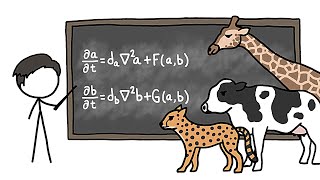

 DB
DB NF
NF A
A AS
AS ML
ML TL
TL