Proc Biol Sci August 2015 PMID 26290074

Hummingbird tongues are elastic micropumps.

Alejandro Rico-Guevara, Tai-Hsi Fan, Margaret A Rubega

Mentions

58
Peak: 1 in May 2016
across 5 sources since May 2016

Extended reach

3,166
potential audience

Total likes

34

Video views

1,779

Mentions per month

May 2016 – Oct 2024

Where it's discussed

  • News39 articles
  • Blogs10 articles
  • Facebook5 posts
  • X / Twitter2 posts
  • YouTube2 videos

AI synopsis

What people are saying

The discussions reflect excitement about the discovery, especially in phrases like 'working like a pump' and calls to watch videos for clearer understanding, which help contextualize the cellular mechanics. The tone balances appreciation for the detailed findings with an interest in their practical implications, making the article approachable and engaging for a broad audience.

AgreementModerate agreement

Most discussions agree that the research unveils a fascinating mechanism behind hummingbird feeding, with some emphasizing how the elastic micropump model explains their rapid licking behavior.

InterestHigh interest

Posts demonstrate high interest, highlighting the biological innovation and sharing intriguing facts like the feeding frequency of 17 Hz, which sparks curiosity.

EngagementModerate engagement

Comments include references to watch videos and further details from the paper, indicating active engagement with specific aspects of the research.

ImpactModerate impact

While some recognize the study's significance for understanding bird physiology, the overall perception is that it has moderate scientific impact rather than a groundbreaking shift.

Abstract in brief

  • Hummingbird tongues function as elastic micropumps that rapidly load nectar through a mechanism involving reexpansion of collapsed tongue grooves, rather than relying on capillary action.
  • High-speed camera observations across multiple hummingbird species showed that during nectar feeding, the tongue compresses and remains flattened until it contacts nectar, then reshapes and fills with nectar without forming menisci.
  • This elastic recovery-based pumping allows hummingbirds to feed at higher rates than capillarity-based models predict, explaining their fast licking behavior and more efficient nectar extraction.

Top posts

Most liked on X and Bluesky
Qikiciting
@qikiciting · X

@qikipedia This paper "Hummingbird tongues are elastic micropumps" https://t.co/Uke6OQi0PA looking at how hummingbirds manage to drink nectar, cites observed licking frequencies of up to 17 Hz (so a particularly fast one might manage 20 times a second)

May 18, 2021 · 10 likes · 338 followers View post →
Simon Joly (@simjoly.bsky.social)
@simjoly · X

Did you know that #hummingbird tongues work like a pump? When it contacts nectar, it opens rapidly to draw nectar inside, and then expulse the nectar in the bill. Watch this great video: https://t.co/OkL61BkTBs More info in paper by @AlejoRicoG : https://t.co/OEnsp8Av50 https://t.co/nss5tF4A4o

Mar 25, 2019 · 3 likes · 1,049 followers View post →

All mentions

Qikiciting
@qikiciting · X

@qikipedia This paper "Hummingbird tongues are elastic micropumps" https://t.co/Uke6OQi0PA looking at how hummingbirds manage to drink nectar, cites observed licking frequencies of up to 17 Hz (so a particularly fast one might manage 20 times a second)

May 18, 2021 · 10 likes · 338 followers View post →
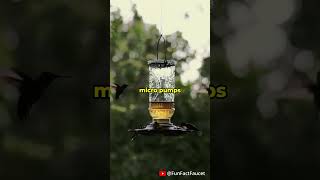
Simon Joly (@simjoly.bsky.social)
@simjoly · X

Did you know that #hummingbird tongues work like a pump? When it contacts nectar, it opens rapidly to draw nectar inside, and then expulse the nectar in the bill. Watch this great video: https://t.co/OkL61BkTBs More info in paper by @AlejoRicoG : https://t.co/OEnsp8Av50 https://t.co/nss5tF4A4o

Mar 25, 2019 · 3 likes · 1,049 followers View post →