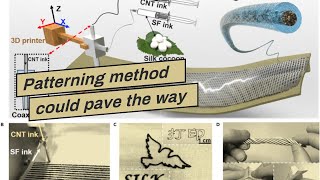
Discussions predominantly praise the article's innovative approach, with comments like 'advancing applications of fiber-based devices' and 'high-throughput fabrication,' demonstrating enthusiasm and recognition of its potential to revolutionize fields like smart textiles and biomedical devices. The tone emphasizes the significance of the method, reflecting high interest and perceived impact.
AgreementModerate agreement
Most discussions support the significance of the research, highlighting its potential applications and advancements.
InterestHigh interest
Participants show strong curiosity about the technological implications and applications in fields like sensors and textiles.
EngagementModerate engagement
Posts mention specific methodologies, such as photolithography and thermal drawing, indicating active engagement with the content.
ImpactHigh impact
The emphasis on broad applications and potential industry influence suggests high perceived impact.
Abstract in brief
The research discusses a new method that combines thermal drawing and photolithography to create multimaterial fibers with customizable, high-density functional interfaces, overcoming the typical symmetry limitations of traditional fibers.
The method uses a two-step polymerization process with specialized photopolymer networks, making the photoresist compatible with high-throughput fiber production in normal atmospheric conditions.
This innovation enables the creation of long fibers with multiple patterned functional points, potentially benefiting applications in sensors, optoelectronics, and smart textiles.]
#ASAP by Polina Anikeeva @AnikeevaLab & team @mit_dmse! Thermally drawable photoresist based on thiol−epoxy/thiol−ene network enables high-throughput fabrication of hundreds of meters of longitudinally patternable multimaterial fibers: https://t.co/26jRY6j7Za https://t.co/VPKFnfwRcO
Dec 2, 2020 · 5 likes · 28,100 followersView post →
CN
Center for Neurotechnology
@ctr4neurotech · X
Recent paper @ACSPublications from Polina Anikeeva, CNT member @MIT. describes an approach that may advance applications of fiber-based devices such as distributed sensors and large area optoelectronic devices. https://t.co/cFmbb7TtFh https://t.co/P6RI5wVr3z
Dec 22, 2020 · 4 likes · 3,394 followersView post →
DK
Dr. Mehmet Kanık
@mmtkanik · X
Our recent article:
Selectively Micro-Patternable Fibers via In-Fiber Photolithography
https://t.co/7OZYX2MCli
Congrats to all!
Youngbin Lee Andrés Canales Gabriel Loke
A new method combining thermal drawing and photolithography enables precise patterning of long multimaterial fibers with embedded functional elements, enhancing their application in smart textiles, biomedicine, and…
This new method combines thermal drawing and photolithography to produce long multimaterial fibers with embedded functional elements, enabling applications in biomedicine, robotics, and smart textiles.
Recent paper @ACSPublications from Polina Anikeeva, CNT member @MIT. describes an approach that may advance applications of fiber-based devices such as distributed sensors and large area optoelectronic devices. https://t.co/cFmbb7TtFh https://t.co/P6RI5wVr3z
Dec 22, 2020 · 4 likes · 3,394 followersView post →
SL
Smart Materials Lab
@materials_lab · X
Multimaterial fiber patterning for smart textile, robotics, biomedicine
https://t.co/76U74TG8hw https://t.co/efiTN1R9vI
#ASAP by Polina Anikeeva @AnikeevaLab & team @mit_dmse! Thermally drawable photoresist based on thiol−epoxy/thiol−ene network enables high-throughput fabrication of hundreds of meters of longitudinally patternable multimaterial fibers: https://t.co/26jRY6j7Za https://t.co/VPKFnfwRcO
Dec 2, 2020 · 5 likes · 28,100 followersView post →
DK
Dr. Mehmet Kanık
@mmtkanik · X
Our recent article:
Selectively Micro-Patternable Fibers via In-Fiber Photolithography
https://t.co/7OZYX2MCli
Congrats to all!
Youngbin Lee Andrés Canales Gabriel Loke