Nature Materials
@NatureMaterials · X
Harnessing dislocation motion using an electric field @IowaStateMSE @PKU1898 @DalhousieU @zou_mse_UofT https://t.co/Ecj8Rbkq21
Jun 21, 2023 · 13 likes · 5 shares · 54,646 followers
View post →
Mentions
Extended reach
Total likes
Video views
AI synopsis
The group collectively praises the study’s innovative approach to controlling dislocations, with phrases like 'game-changing' and references to real-time experiments. The tone is excited and optimistic, showing both curiosity and belief in the research's transformative potential.
Most discussions express enthusiasm and support for the findings, highlighting the novelty of manipulating dislocation motion with electric fields.
Posts show high curiosity, with many mentioning potential applications and real-time observations, indicating strong interest.
Commenters reference specific aspects of the research, such as real-time experiments and charge control, demonstrating meaningful engagement.
The tone suggests that the research could significantly influence materials science and engineering, emphasizing its potential for future technological advancements.
Harnessing dislocation motion using an electric field @IowaStateMSE @PKU1898 @DalhousieU @zou_mse_UofT https://t.co/Ecj8Rbkq21
Can we use an electric field to control the movement of crystal defects? In today’s Nature Materials, our group and collaborators publish a paper entitled 'Harnessing dislocation motion using an electric field', in which we present real-time observations…https://t.co/mrn8Ag4hrl
Harnessing dislocation motion using an electric field https://t.co/6KDOVDshgG 転位の電場制御、面白そう
Related paper: Harnessing dislocation motion using an electric field https://t.co/Ecj8Rbkq21
RT @NatureMaterials: Harnessing dislocation motion using an electric field @IowaStateMSE @PKU1898 @DalhousieU @zou_mse_UofT https://t.co/Ec…
[2211.14933] Mingqiang Li, Yidi Shen, Kun Luo et al.: Harnessing dislocation motion using an electric field https://t.co/3MPlZi8jeV https://t.co/9xZXCtYLev #cond_mat_mtrl_sci

Dislocation motion is crucial for material plasticity and can be manipulated using electric fields. Real-time experiments on zinc sulfide demonstrate dislocation movement influenced by electric field orientation…
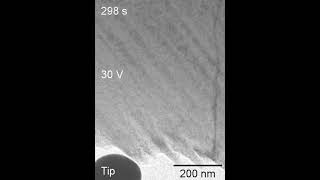
Real-time in situ TEM observation shows how an electric field influences dislocation motion in zinc sulfide, demonstrating a new method to manipulate material properties by applying voltage.

Dislocation motion influences material plasticity. This study demonstrates how electric fields can manipulate dislocations, revealing charge effects and reducing energy barriers, offering new avenues for materials…

Real-time observations of dislocation movement in zinc sulfide demonstrate that electric fields can manipulate dislocation motion, influencing material plasticity by lowering energy barriers for dislocation movement.

Dislocation motion is crucial for material plasticity and can be manipulated using electric fields. Real-time experiments on zinc sulfide demonstrate how dislocations move directionally in response to electric field…
Related paper: Harnessing dislocation motion using an electric field https://t.co/Ecj8Rbkq21
RT @NatureMaterials: Harnessing dislocation motion using an electric field @IowaStateMSE @PKU1898 @DalhousieU @zou_mse_UofT https://t.co/Ec…
RT @NatureMaterials: Harnessing dislocation motion using an electric field @IowaStateMSE @PKU1898 @DalhousieU @zou_mse_UofT https://t.co/Ec…
RT @NatureMaterials: Harnessing dislocation motion using an electric field @IowaStateMSE @PKU1898 @DalhousieU @zou_mse_UofT https://t.co/Ec…
RT @NatureMaterials: Harnessing dislocation motion using an electric field @IowaStateMSE @PKU1898 @DalhousieU @zou_mse_UofT https://t.co/Ec…
Harnessing dislocation motion using an electric field @IowaStateMSE @PKU1898 @DalhousieU @zou_mse_UofT https://t.co/Ecj8Rbkq21
Can we use an electric field to control the movement of crystal defects? In today’s Nature Materials, our group and collaborators publish a paper entitled 'Harnessing dislocation motion using an electric field', in which we present real-time observations…https://t.co/mrn8Ag4hrl
Harnessing dislocation motion using an electric field https://t.co/6KDOVDshgG 転位の電場制御、面白そう
[2211.14933] Mingqiang Li, Yidi Shen, Kun Luo et al.: Harnessing dislocation motion using an electric field https://t.co/3MPlZi8jeV https://t.co/9xZXCtYLev #cond_mat_mtrl_sci