The discussions reveal strong alignment with the publication, with phrases like 'raises questions about use of thin walled hives' and calls to 'change the basic way we keep bees' showing concern and intent to act, while the tone highlights the importance of animal welfare and scientific findings as catalyst for change.
AgreementStrong agreement
Most discussions strongly agree that the research reveals that clustering stresses bees rather than insulates them, with many posts emphasizing the welfare implications and questioning traditional hive designs.
InterestHigh interest
Posts demonstrate high interest, with many highlighting the significance of the discovery and calling for changes in beekeeper practices, indicating active concern and engagement with the topic.
EngagementHigh engagement
Several discussions delve into the implications, such as criticizing current hive methods or expressing empathy for bee welfare, showing deep engagement and reflection.
ImpactModerate impact
The dialogues suggest potential for changing how beekeeping is approached, although some express cautious optimism, implying the research could influence future practices but may require further validation or action.
Abstract in brief
The study challenges the traditional view that honeybee winter clustering acts as insulation; instead, it suggests that clustering actually increases heat transfer and stress for the bees.
Researchers found that when honeybees form a dense cluster, their thermal conductivity roughly doubles, and insulation can decrease significantly, meaning the cluster is not effectively protecting them from cold.
The findings imply that clustering is a stressful behavioral response to environmental threats, and intentionally forcing bees into these clusters (e.g., through poor insulation or refrigeration) may be considered inhumane or cruel.]
The #honeybee mantle provides inadequate insulation in the winter, leading to forced clustering in commercial hives: https://t.co/OOnjBGLAJJ #JRSocInterface @LeedsUniEng
Nov 28, 2023 · 15 likes · 3 shares · 38,612 followersView post →
AC
Api:Cultural
@apiculturalLdn · X
New evidence that winter clustering in honey bees is a stress response and not effective insulation response. Raises questions about use of thin walled hives and welfare treatment of bees. https://t.co/xZE2yjEa76
Nov 26, 2023 · 4 likes · 2,644 followersView post →
RP
Royal Society Publishing
@RSocPublishing · X
#JRSocInterface in @guardian | Honeybee cluster—not insulation but stressful heat sink: https://t.co/z9mpAASPaT https://t.co/rw4IP0BP5I
Dec 14, 2023 · 3 likes · 38,612 followersView post →
Nov 22, 2023 · 3 likes · 1 share · 940 followersView post →
RP
Royal Society Publishing
@RSocPublishing · X
The honeybee mantle provides inadequate insulation in the winter, leading to forced clustering in commercial hives: https://t.co/OOnjBGLAJJ #JRSocInterface @LeedsUniEng https://t.co/ZNgRMAguIz
Nov 25, 2023 · 2 likes · 38,612 followersView post →
The study shows that honeybee clustering is not insulation but a stressful heat sink, increasing heat transfer and stress for bees, challenging traditional views on winter behavior.
Clustering is not a blanket for warmth but a stressful heat sink that increases heat transfer and stress for honeybees, challenging traditional views on winter bee behavior.
A recent study challenges the traditional view that honeybee winter clusters act as insulation. It suggests that clustering increases heat transfer and stress, indicating that the behavior may be a stressful response…
Commercial hive designs may have exposed bees to unnecessary cold, as new research shows clustering increases heat transfer and stress, rather than insulates them. We explore ways to improve hive insulation for bee…
Review the seasonal beekeeping management strategies in Michigan, including honey bee swarms, queen events, varroa control, and more, based on the Michigan State University Apiculture Team webinar.
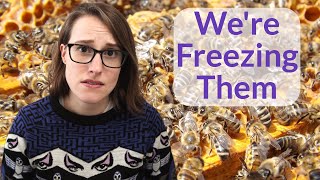
In this episode, we explore new research showing that honeybee clusters increase heat transfer and stress during winter, challenging traditional views of insulation. Learn what this means for beekeeping and bee welfare.
The #honeybee mantle provides inadequate insulation in the winter, leading to forced clustering in commercial hives: https://t.co/OOnjBGLAJJ #JRSocInterface @LeedsUniEng
Nov 28, 2023 · 15 likes · 3 shares · 38,612 followersView post →
AC
Api:Cultural
@apiculturalLdn · X
New evidence that winter clustering in honey bees is a stress response and not effective insulation response. Raises questions about use of thin walled hives and welfare treatment of bees. https://t.co/xZE2yjEa76
Nov 26, 2023 · 4 likes · 2,644 followersView post →
RP
Royal Society Publishing
@RSocPublishing · X
The honeybee mantle provides inadequate insulation in the winter, leading to forced clustering in commercial hives: https://t.co/OOnjBGLAJJ #JRSocInterface @LeedsUniEng https://t.co/ZNgRMAguIz
Nov 25, 2023 · 2 likes · 38,612 followersView post →
AN
Atomic Nuc
@AtomicNucs · X
https://t.co/g6Na6GwCGP
IMO, we need to change the basic way we keep bees.
Honeybee cluster—not insulation but stressful heat sink. University of Leeds. Journal: Journal of The Royal Society Interface; DOI: 10.1098/rsif.2023.0488 ...
Honeybee cluster—not insulation but stressful heat sink | EurekAlert!
News
... 10.1098/rsif.2023.0488. ENDS. Journal. Journal of The Royal Society Interface. DOI. 10.1098/rsif.2023.0488. Subject of Research. Not applicable ...
 RP
RP AC
AC サ
サ


 DM
DM BC
BC PA
PA JP
JP DO
DO SG
SG AN
AN B
B 猫
猫