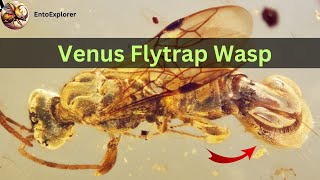
Numerous posts highlight the captivating details from the study, with users expressing astonishment at the 'Venus flytrap-like abdomen' of the wasp and its predatory adaptations. Phrases like 'bizarre creature' and 'kind of terrifying' indicate that the unique attributes of the wasp have sparked imaginative reflection, while references to its potential evolutionary implications demonstrate a blend of fascination and a serious consideration of its biological significance.
AgreementStrong agreement
The discussions generally show strong support for the findings presented in the publication, reflecting appreciation for the discovery.
InterestHigh interest
High levels of interest are evident, as participants express curiosity about the unique features of the ancient wasp and its adaptations.
EngagementModerate engagement
While many discussions share basic commentary, a few delve deeply into the implications of the findings, indicating some depth of engagement.
ImpactHigh impact
Many participants perceive the research as having significant implications for our understanding of evolutionary biology and the diversity of ancient insects.
Abstract in brief
The study introduces a new genus and species of wasp, Sirenobethylus charybdis, discovered in mid-Cretaceous Kachin amber, highlighting unique abdominal modifications that resemble a grasping mechanism.
The fossilized wasps exhibit notable morphological features, including three flaps on the abdomen that function similarly to a Venus flytrap, setting them apart from any known insect.
Phylogenetic analysis positions the new family within the Chrysidoidea superfamily, indicating a diverse evolution of parasitoid strategies among these insects in the Cretaceous period compared to modern counterparts.
#A 99-million-year-old parasitic wasp, preserved in amber, used a Venus flytrap-like abdomen to capture prey. This extinct species may represent a new insect family with unique parasitoid strategies. @biomedcentral https://t.co/QXJJMgRDmP https://t.co/Jv7k1M11RO
Mar 26, 2025 · 22 likes · 11 shares · 1,024,119 followersView post →
This video presents a fascinating discovery of a new wasp species, Sirenobethylus charybdis, found in mid-Cretaceous Kachin amber. The fossilized wasp exhibits remarkable abdominal modifications resembling a Venus…
Scientists found a remarkable fossil wasp, Sirenobethylus charybdis, in mid-Cretaceous amber. This specimen has unique abdominal modifications resembling a grasping mechanism, similar to a Venus flytrap, highlighting…
This video explores the remarkable Sirenobethylus charybdis, a new genus of wasp from mid-Cretaceous Kachin amber. It features unique abdominal modifications that resemble a grasping mechanism, highlighting the…
This week has many dubious claims, but among them is promising news from China about flying taxis. Additionally, a new genus and species of wasp, Sirenobethylus charybdis, showcases unique abdominal modifications…
What do you get when you have a wasp that can grab things with its butt? An ancient insect trapped in amber has shown us this very thing! Check out the info in our latest #YouTube short!
#scicomm #sciants #stem #science
youtu.be/VGv_UvWZAco
RT @SpringerJapan: Taiping Gao、Lars Vilhelmsenらの@BMCBiology #OA #論文
A cretaceous fly trap? remarkable abdominal modification in a fossil wa…
May 29, 2025 · 5 shares · 6,310 followersView post →
岩I
岩瀬 哲 (Akira Iwase)
@Docbenitake · X
RT @SpringerJapan: Taiping Gao、Lars Vilhelmsenらの@BMCBiology #OA #論文
A cretaceous fly trap? remarkable abdominal modification in a fossil wa…
May 28, 2025 · 5 shares · 861 followersView post →
NJ
Nature Japan
@NatureJapan · X
RT @SpringerJapan: Taiping Gao、Lars Vilhelmsenらの@BMCBiology #OA #論文
A cretaceous fly trap? remarkable abdominal modification in a fossil wa…
May 28, 2025 · 5 shares · 91,070 followersView post →
風か
風信子(かのこ)
@hyacinth_tde · X
RT @mikage__akari: 画像の下段のように開いていたのだろうか。実際に挟んでいたとしてその速度なども気になるね!
Wu Q, Vilhelmsen L, Li X, Zhuo D, Ren D, Gao T. A cretaceous fly trap? rem…
May 26, 2025 · 1 share · 5,412 followersView post →
三
三日月あかり
@mikage__akari · X
画像の下段のように開いていたのだろうか。実際に挟んでいたとしてその速度なども気になるね!
Wu Q, Vilhelmsen L, Li X, Zhuo D, Ren D, Gao T. A cretaceous fly trap? remarkable abdominal modification in a fossil wasp. BMC Biol. 2025 Mar 27;23(1):81.
https://t.co/izOa6Ok38Q https://t.co/tLhC7rUboO
May 26, 2025 · 4 likes · 1 share · 900 followersView post →
吉Y
吉野 隆 / Takashi Yoshino
@takashiyoshino · X
RT @SpringerJapan: Taiping Gao、Lars Vilhelmsenらの@BMCBiology #OA #論文
A cretaceous fly trap? remarkable abdominal modification in a fossil wa…
May 25, 2025 · 5 shares · 162 followersView post →
SJ
Springer Japan
@SpringerJapan · X
Taiping Gao、Lars Vilhelmsenらの@BMCBiology #OA #論文
A cretaceous fly trap? remarkable abdominal modification in a fossil wasp
https://t.co/CNVW8AfzhN
#オープンアクセス
化石:#琥珀 に保存された古代の寄生性「ハエトリグサ」のスズメバチ
https://t.co/wLR49z8VlB
@koebenhavns_uni https://t.co/dMgmejebcn
May 25, 2025 · 1 like · 5 shares · 8,260 followersView post →
May 22, 2025 · 6 likes · 2 shares · 12,884 followersView post →
A
adeliebiology
@adeliebiology · X
แตนเบียนจากยุคไดโนเสาร์ที่น่าจะใช้หางงับเหยื่อแบบต้นกาบหอยแครงแล้วฉีดไข่เข้าไป อมก
A cretaceous fly trap? remarkable abdominal modification in a fossil wasp: https://t.co/3JHt8CASFq https://t.co/LkC4qAfCoi
A study in @BMCBiology finds that specimens of Sirenobethylus charybdis — named for the sea monster in Greek mythology which swallowed and disgorged water thrice a day — date from almost 99 million years ago and may represent a new family of insects.
https://t.co/6SXn4YAbBW https://t.co/eZRbrmhbLm
So the ancient insects were kind of terrifying. One wasp had a butt like a venus fly trap to catch prey of a sorts. The prey was for the eggs it injected and left to grow and eat their way to freedom. No thank you. https://t.co/bl0IauByBb https://t.co/yiq9KMPxiH
Mar 31, 2025 · 4 shares · 6,310 followersView post →
SN
Springer Nature
@SpringerNature · X
An extinct lineage of parasitic wasps dating from the mid-Cretaceous period and preserved in amber may have used their Venus flytrap-like abdomen to capture and immobilise their prey: https://t.co/uDiXjzZMSa
@BMCBiology
Mar 31, 2025 · 1 like · 82,675 followersView post →
Mar 31, 2025 · 4 shares · 91,070 followersView post →
SJ
Springer Japan
@SpringerJapan · X
【注目のハイライト】化石:琥珀に保存された古代の寄生性「ハエトリグサ」のスズメバチ
https://t.co/gBn9e1crtr
Taiping Gao、Lars Vilhelmsenらの@BMCBiology #OA #論文
A cretaceous fly trap? remarkable abdominal modification in a fossil wasp
https://t.co/CNVW8Ag77l
#オープンアクセス https://t.co/mKwapFhzBq
Mar 31, 2025 · 9 likes · 4 shares · 8,260 followersView post →
AS
astroilich.bsky.social
@astroilich.bsky.social · Bluesky
A cretaceous fly trap? remarkable abdominal modification in a fossil wasp.
Sirenobethylus charybdis probably was a parasitoid wasp; the abdominal grasping apparatus may have been used to temporarily immobilize the host during oviposition.
bmcbiol.biomedcentral.com/articles/10....
A cretaceous fly trap? Remarkable abdominal modification in a fossil wasp https://bmcbiol.biomedcentral.com/articles/10.1186/s12915-025-02190-2 (https://news.ycombinator.com/item?id=43508817)
A cretaceous fly trap? remarkable abdominal modification in a fossil wasp
#HackerNews
https://bmcbiol.biomedcentral.com/articles/10.1186/s12915-025-02190-2
A cretaceous fly trap? remarkable abdominal modification in a fossil wasp
L: https://bmcbiol.biomedcentral.com/articles/10.1186/s12915-025-02190-2
C: https://news.ycombinator.com/item?id=43508817
posted on 2025.03.28 at 14:55:00 (c=0, p=4)
Check out our latest #OpenAccess publication - a new species of parasitic wasp, found fossilized in amber that lived with the dinosaurs 99 million years ago, had a flytrap like apparatus they used to capture and force other creatures to shelter their young https://t.co/U10EtyJcSI https://t.co/xSZYdqvXKR
Mar 28, 2025 · 1 like · 9,009 followersView post →
RT @physorg_com: #A 99-million-year-old parasitic wasp, preserved in amber, used a Venus flytrap-like abdomen to capture prey. This extinct…
Mar 26, 2025 · 11 shares · 73 followersView post →
T
TrollColors
@TrollColors · X
RT @physorg_com: #A 99-million-year-old parasitic wasp, preserved in amber, used a Venus flytrap-like abdomen to capture prey. This extinct…
Mar 26, 2025 · 11 shares · 1,248 followersView post →
K
KaizenPerformance
@KaizenPerf · X
RT @physorg_com: #A 99-million-year-old parasitic wasp, preserved in amber, used a Venus flytrap-like abdomen to capture prey. This extinct…
Mar 26, 2025 · 11 shares · 273 followersView post →
EG
Erkan Guntore
@erkanguntore · X
RT @physorg_com: #A 99-million-year-old parasitic wasp, preserved in amber, used a Venus flytrap-like abdomen to capture prey. This extinct…
Mar 26, 2025 · 11 shares · 3,643 followersView post →
PO
Phys.org
@physorg_com · X
#A 99-million-year-old parasitic wasp, preserved in amber, used a Venus flytrap-like abdomen to capture prey. This extinct species may represent a new insect family with unique parasitoid strategies. @biomedcentral https://t.co/QXJJMgRDmP https://t.co/Jv7k1M11RO
Mar 26, 2025 · 22 likes · 11 shares · 1,024,119 followersView post →